Why One 'Best' Gutter Guard Doesn't Exist for All Leaves
Walk through any neighborhood in autumn and you'll see completely different leaf situations house to house. One property battles massive sycamore leaves that lay flat like dinner plates. Next door, someone's dealing with tiny locust leaves that slip through openings like confetti. Three houses down, it's pine needles building up like thatch.
Each scenario demands different filtration characteristics.
What blocks large leaves effectively often lets smaller debris through. Systems designed for fine filtration can become blanketed by wet leaves that create a solid mat. The gutter guard that works brilliantly for your sister across town might fail completely at your house simply because different trees drop different debris.
Leaf Type and Size Variations
Oak leaves are thick, rigid, and tend to curl as they dry — which means they can bridge across micro mesh surfaces and block water flow even when the mesh itself isn't clogged. Maple leaves are larger and flatter when wet, creating temporary dams on low-slope surfaces before eventually sliding off or breaking down.
Smaller leaves from trees like birch, elm, and honey locust present the opposite problem: they're sized perfectly to slip through larger screen openings and decompose directly in your gutters.
Then there's shape. Sweetgum balls, catalpa pods, and helicopter seeds from maples don't behave like leaves at all. Some gutter guards that excel with standard leaf debris struggle with these three-dimensional objects that wedge into openings or accumulate at entry points.
| Leaf Type | Size/Shape | Main Challenge | Best Guard Type |
|---|---|---|---|
| Oak/Maple | Large, flat to curled | Surface bridging, water dams | Surface tension systems |
| Birch/Elm/Locust | Small, lightweight | Slips through openings | Micro mesh |
| Pine Needles | Thin, flexible | Penetrates screens, mats up | Fine micro mesh |
| Sweetgum/Seed Pods | 3D objects | Wedges in openings | Solid surface designs |
Pine Needles: A Different Challenge
Pine needles don't play by leaf rules. They're small-diameter, flexible, and disturbingly good at working through openings that would stop leaves cold.
A standard screen with quarter-inch holes will stop oak leaves perfectly while letting pine needles sail straight through to pack your gutters solid.
The needles that cause the most problems are fresh green ones that still have moisture and weight — they don't blow away like dry needles do. Homeowners in heavily wooded pine areas report that some popular gutter guards require cleaning just as often as open gutters, just now they're clearing the top surface instead of inside the gutter channel. The needles layer up like pick-up sticks, trapping smaller debris and eventually forming a dense mat that sheds water right over the gutter edge.
Needle diameter matters too. Longleaf pine needles are longer and coarser than white pine needles. Spruce needles are shorter and finer still. A micro mesh system that handles longleaf successfully might still accumulate layers of fine spruce needles that require periodic clearing.
How Different Gutter Guard Types Handle Leaves
Every gutter guard system relies on some combination of filtration and water flow physics. Understanding these mechanics helps explain why certain products work well in specific situations but fail in others.
Micro Mesh Systems and Leaf Coverage
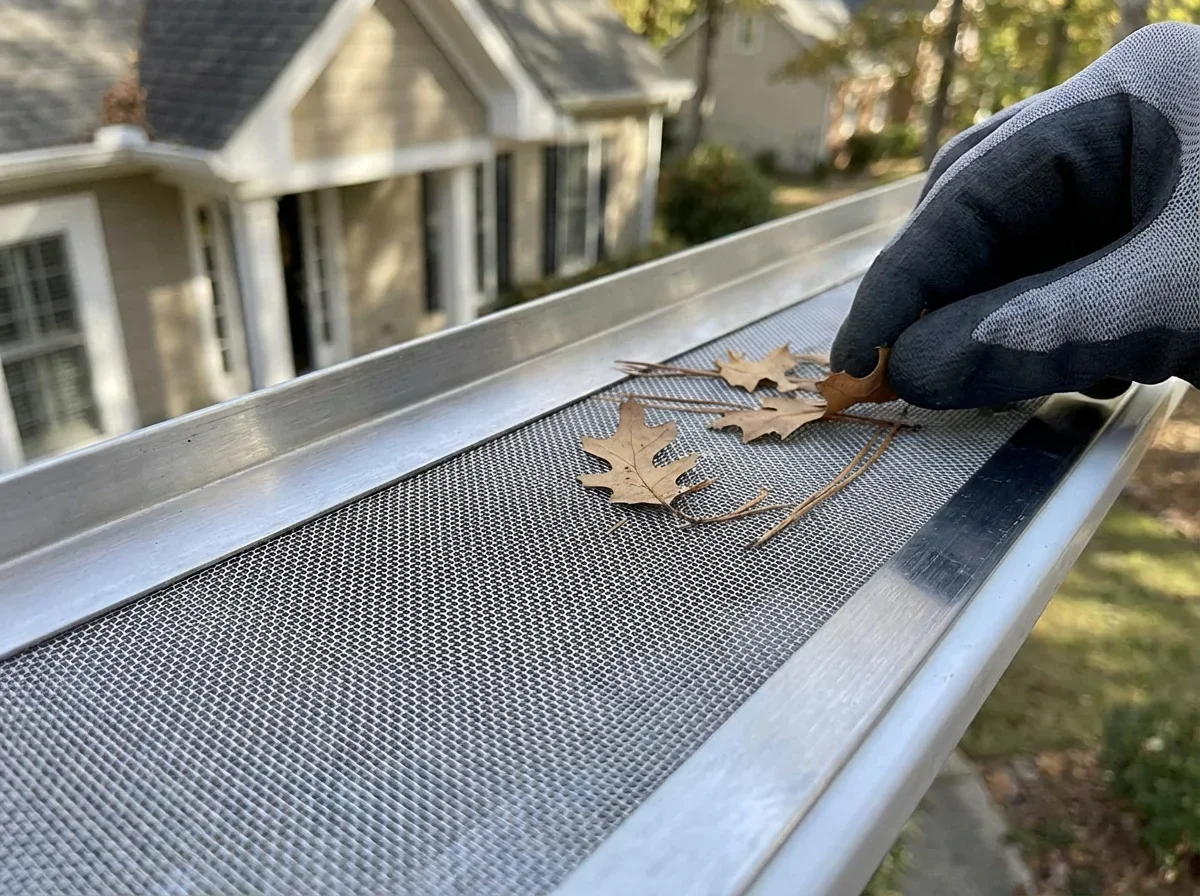
Micro mesh guards use surgical-grade stainless steel or fine aluminum mesh with openings measured in microns — small enough that even shingle grit can't pass through. This ultra-fine filtration keeps everything on top of the surface, including all leaf types and pine needles.
When they work well, leaves simply rest on the surface and blow off or wash away during rain.
But this depends entirely on whether leaves actually release from the mesh. On shallow roof pitches or in sheltered areas, wet leaves stick to the mesh surface through surface adhesion. As more leaves accumulate, they form a soggy blanket that deflects water instead of letting it pass through to the gutter below.
Contractors see this most often under dense canopy where leaves stay damp. The micro mesh does its job perfectly — nothing gets into the gutter — but the homeowner still climbs ladders to brush debris off the surface.
Installation angle matters here. Mesh systems pitched more steeply shed leaves better, but that angle needs to match the roof slope and gutter position, which isn't always achievable depending on fascia configuration.
Shingle grit and pollen will pass through some mesh products over time, creating a fine sediment layer in gutters even when larger debris stays out. Most homeowners find this acceptable compared to leaf-packed gutters, but "never clean your gutters again" doesn't account for this gradual accumulation.
Surface Tension and Reverse Curve Systems
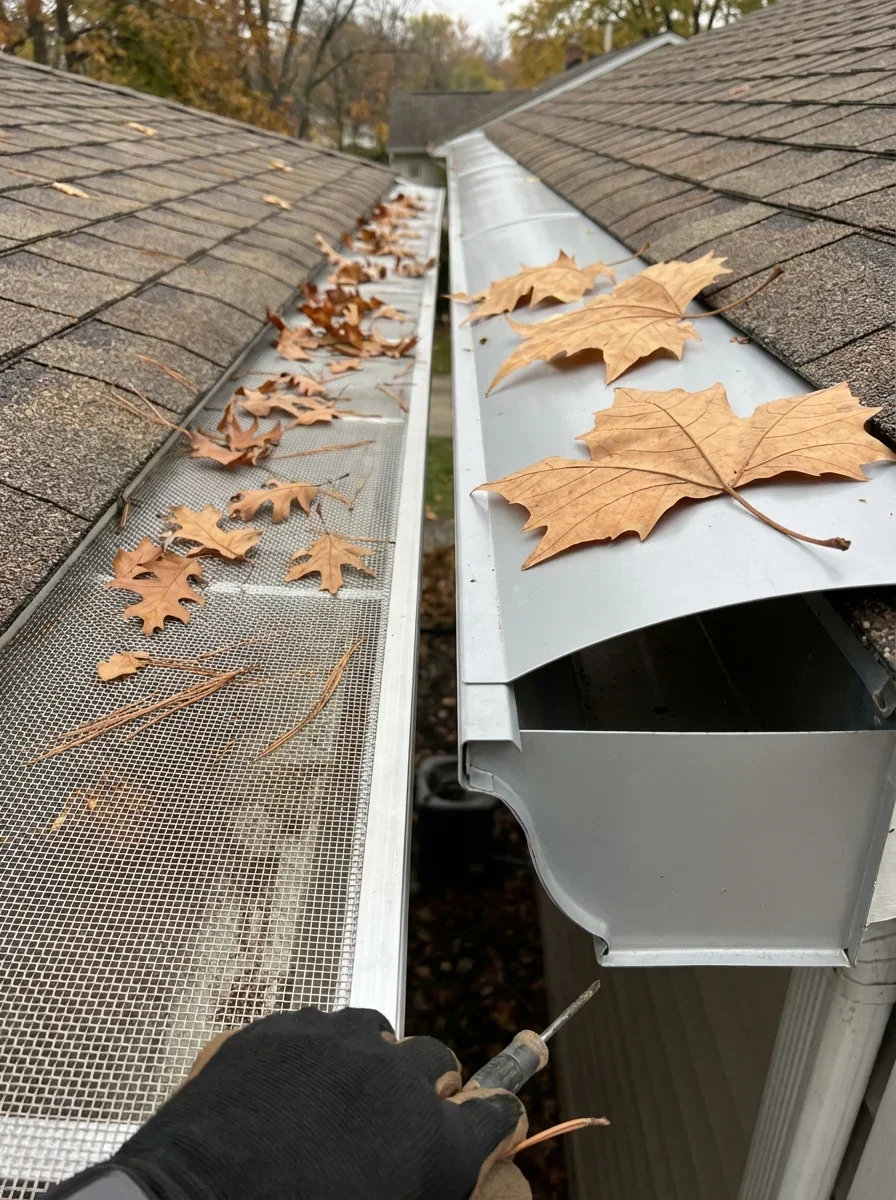
Surface tension guards rely on water's tendency to cling to surfaces as it flows. These systems curve water around a nose or slope into the gutter while leaves theoretically shoot off the edge.
When conditions align — moderate rainfall, dry leaves, sufficient roof pitch — they perform impressively.
The problem comes when leaves get wet. A damp oak leaf weighs enough that it doesn't blow away easily, and it clings to the curved surface through simple adhesion. As more leaves pile up, they create a dam at the curve's nose. Water still follows the curve underneath this leaf pile, but only to a point. During heavy rainfall, water volume overwhelms the narrow entry slot and sheets right over the front of the gutter.
Homeowners with these systems frequently mention clearing leaf buildup from the curved surface — not constantly, but enough that the "install and forget" promise doesn't materialize. For many people dealing with mature trees, "clear a few times a season" instead of monthly gutter cleanings is still a meaningful improvement.
Some contractors hesitate to install surface tension systems on homes with steep roofs and heavy leaf drop because the increased water velocity makes it harder for the system to capture flow during downpours when leaves are also present.
Screen Systems: When They Work
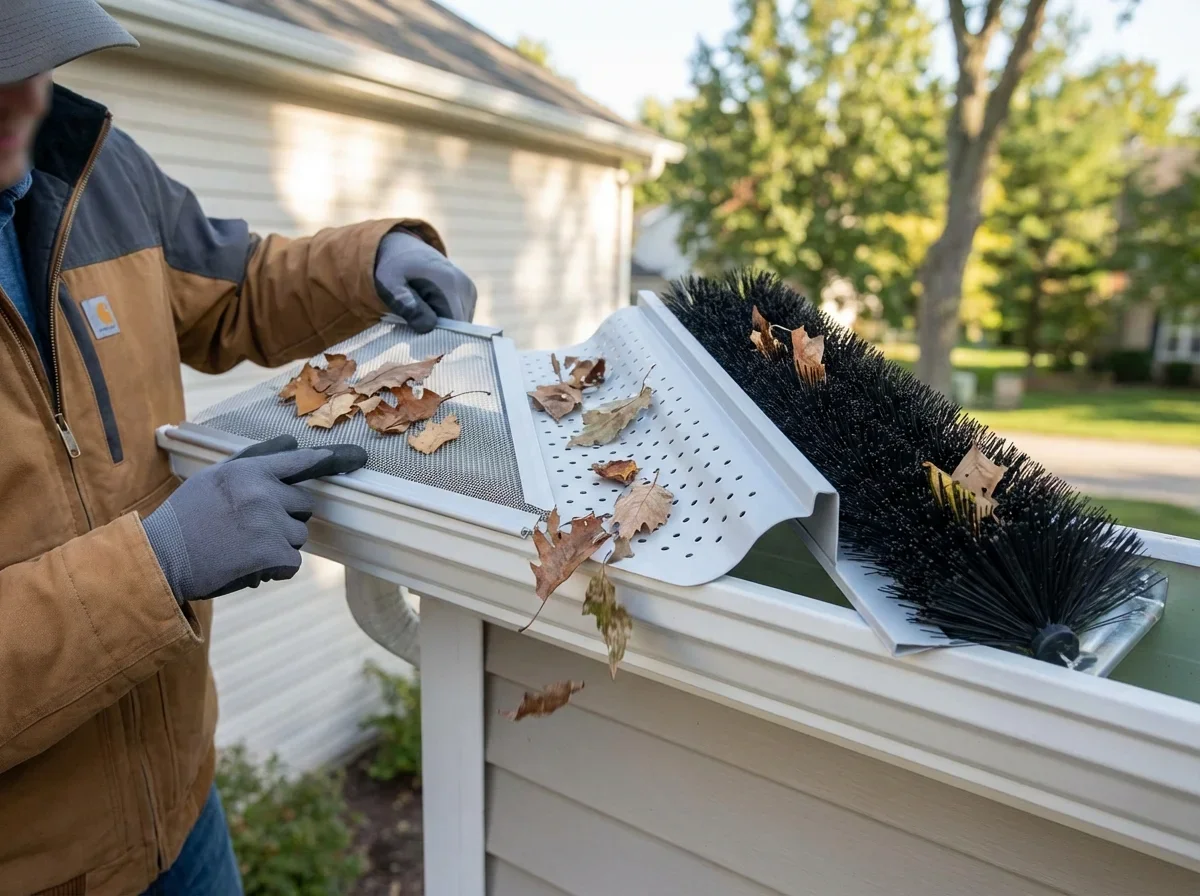
Basic aluminum or plastic screens with quarter-inch to half-inch perforations are the budget option. They stop large leaves and keep animals out while allowing smaller debris through. Contractors typically recommend these only in specific situations: light tree coverage with large-leaf species, or as a temporary solution for homeowners not ready to invest in premium systems.
Under oak, maple, or sycamore trees with moderate density, these screens do prevent the worst clogging while still requiring occasional gutter cleaning for the material that passes through.
It's a middle-ground approach that reduces maintenance frequency without eliminating it.
Where screens fail completely is under pine or mixed hardwood/pine coverage. The openings that work fine for large leaves become highways for pine needles, and you're back to packed gutters within a season. Some homeowners mention that removing screens for cleaning is more difficult than just cleaning open gutters — the screens trap wet leaf matter that has to be scraped off before you can even access the gutter channel below.
What Contractors Evaluate Before Recommending Systems
Experienced installers don't lead with a product — they assess your specific situation first. Tree species identification comes first because it determines debris type and volume.
A property surrounded by mature deciduous hardwoods faces a concentrated two-month leaf drop. The same house with mixed pine coverage deals with year-round needle shed at lower volume but higher frequency.
Proximity matters as much as species. Trees with branches extending directly over the roofline drop debris with no wind assistance — everything falls straight down onto the gutter system. Trees set back from the house drop leaves that blow onto the roof and may slide off before reaching gutters, depending on roof pitch.
Distance also affects moss and algae growth on gutter guard surfaces in damp climates. Shaded areas under close canopy stay wet longer, which influences which systems will release debris effectively versus which will accumulate damp leaf layers.
Roof pitch changes everything about water velocity and debris behavior. On steep roofs (8/12 pitch or greater), water and debris rush down with enough force that many gutter guard systems struggle to capture flow during heavy rain. Micro mesh can work here because the large surface area gives water more opportunity to pass through. Surface tension systems often underperform because water velocity makes it harder to redirect flow into the narrow entry slot.
Gutter size and existing fascia configuration determine which systems are physically installable. A five-inch K-style gutter with standard fascia mounting offers different options than a six-inch half-round gutter on crown molding detail. Some properties have architectural features that simply preclude certain gutter guard types, regardless of how well they'd handle the leaf situation.
Pro Tip: Before any installer gives you a quote, they should spend at least 15 minutes examining your roof, identifying nearby trees, and checking your current gutter condition. If they quote a system in under 5 minutes without asking about your trees, find someone else.
Maintenance Reality by System Type
Every gutter protection system reduces maintenance compared to open gutters under tree coverage — but "reduces" and "eliminates" are very different outcomes. Understanding what each system type requires helps set realistic expectations.
Micro mesh systems need the least interior gutter cleaning since virtually nothing penetrates the filter. But the surface requires attention. In heavy leaf environments, expect to blow or brush debris off the mesh two to four times per season.
This takes minutes with a leaf blower from the ground or roof edge, versus hours on a ladder cleaning open gutters.
The difference is significant, but it's not zero maintenance. Homeowners with moss or algae issues mention needing to scrub the mesh occasionally because these organisms grow on the surface and reduce water passage. This is most common in Pacific Northwest climates or other areas with extended damp seasons.
Surface tension and reverse curve systems typically need leaf clearing from the curved surface three to six times during fall under heavy tree coverage. The frequency depends entirely on how sheltered and shaded the location is. Exposed sections where wind blows debris away need less attention. Protected areas under dense canopy need more frequent clearing.
Screen systems with larger perforations don't reduce interior gutter cleaning frequency as dramatically. You'll still need to clean inside the gutters periodically, though perhaps annually instead of quarterly. The screens themselves trap matted leaf material on top that needs removal before accessing the gutters below.
The bottom line contractors emphasize: gutter guards are maintenance reduction systems, not maintenance elimination systems — especially under significant tree coverage.
Products marketed as "never clean your gutters again" set homeowners up for disappointment when reality doesn't match the promise. The right system for your tree situation might cut maintenance by 80%, which is transformative even if it's not 100%.
Annual Maintenance Expectations by System Type:
- Micro Mesh: 2-4 surface cleanings per year, minimal interior cleaning
- Surface Tension/Reverse Curve: 3-6 debris clearings during fall season
- Basic Screens: 1-2 full interior gutter cleanings, plus screen debris removal
- No Guards (Open Gutters): 4-6+ full cleanings under heavy tree coverage
- Reality Check: Premium systems typically reduce maintenance by 70-85%, not 100%
Find Gutter Pros Who Understand Your Tree Coverage
The contractor you choose matters as much as the system they install. Installation quality determines whether a gutter guard performs according to its design specs or underperforms due to improper pitch, inadequate fastening, or poor fit to your existing gutter profile.
Look for installers who ask detailed questions about your trees before proposing solutions. Someone who recommends the same product for every home regardless of tree coverage probably isn't tailoring advice to your situation.
Ask what they've installed on properties with similar tree species and coverage density — and whether they've gone back to address performance issues.
Honest contractors acknowledge when systems don't perform as expected and what conditions cause problems.
Get multiple quotes comparing different system types, not just price variations on the same product. Understanding why one contractor recommends micro mesh while another suggests a surface tension system tells you whether they're evaluating your specific needs. Ask about warranty coverage for both product and installation, and what maintenance the warranty requires to remain valid. Some warranties void if you don't clear debris periodically, which contradicts "maintenance-free" marketing claims.