
What Are Copper Gutters?
Copper gutters are seamless or sectional rainwater management systems crafted from solid copper sheets, typically 16 or 20 ounce weight. Contractors form these into gutter profiles—most commonly half-round or K-style—and install them with hidden brackets that maintain clean sightlines.
The material itself is naturally corrosion-resistant, which means it won't rust through like steel or degrade like aluminum.
What sets copper apart is how it ages. Fresh installations gleam with a reddish-brown metallic finish, but within months, you'll notice a darker bronze tone developing. Over years, that transforms into the green-blue patina homeowners either love or didn't realize they were signing up for.
This oxidation layer actually protects the underlying metal, extending lifespan far beyond painted systems that need periodic refinishing.
How Copper Develops Patina Over Time
The patina process starts with oxidation—copper's natural reaction to air and moisture. In dry climates, this might take a decade or longer to reach that iconic verdigris green.
In coastal or humid regions like parts of Wisconsin near the Great Lakes, you could see substantial color change within two to three years.
You can't rush genuine patina, and attempting to accelerate it with chemical treatments often produces uneven results. Some homeowners prefer to let nature handle the timeline, while others actively maintain the bright copper finish with specialized sealants and periodic polishing. Once patina forms, it's remarkably stable—it won't flake off or stain your siding like rust from steel gutters.
Lifespan Compared to Aluminum and Steel
Copper gutter systems routinely last 50 to 100 years with minimal intervention.[2]
That's not marketing hyperbole—many historic buildings still operate with their original copper drainage installed in the early 1900s. Aluminum, by contrast, typically needs replacement after 20 to 30 years, and steel gutters often fail sooner due to rust penetration at seams and fastener points.
The longevity advantage compounds over time. While you might replace aluminum gutters twice or even three times during copper's lifespan, the cumulative cost of those replacements plus installation labor starts to narrow the value gap.
Copper also maintains structural integrity better—it won't dent as easily as aluminum, and it handles snow load and ice damming with less deformation.
| Material | Typical Lifespan | Corrosion Resistance | Maintenance Needs | Appearance Over Time |
|---|---|---|---|---|
| Copper | 50-100 years | Excellent (develops protective patina) | Minimal (debris removal only) | Develops distinctive green-blue patina |
| Aluminum | 20-30 years | Moderate (painted finish protects) | Periodic repainting | Paint fades, may chalk or peel |
| Steel | 15-25 years | Poor (prone to rust) | Regular rust treatment | Rust stains, structural degradation |
Half-Round Gutter Profiles Explained
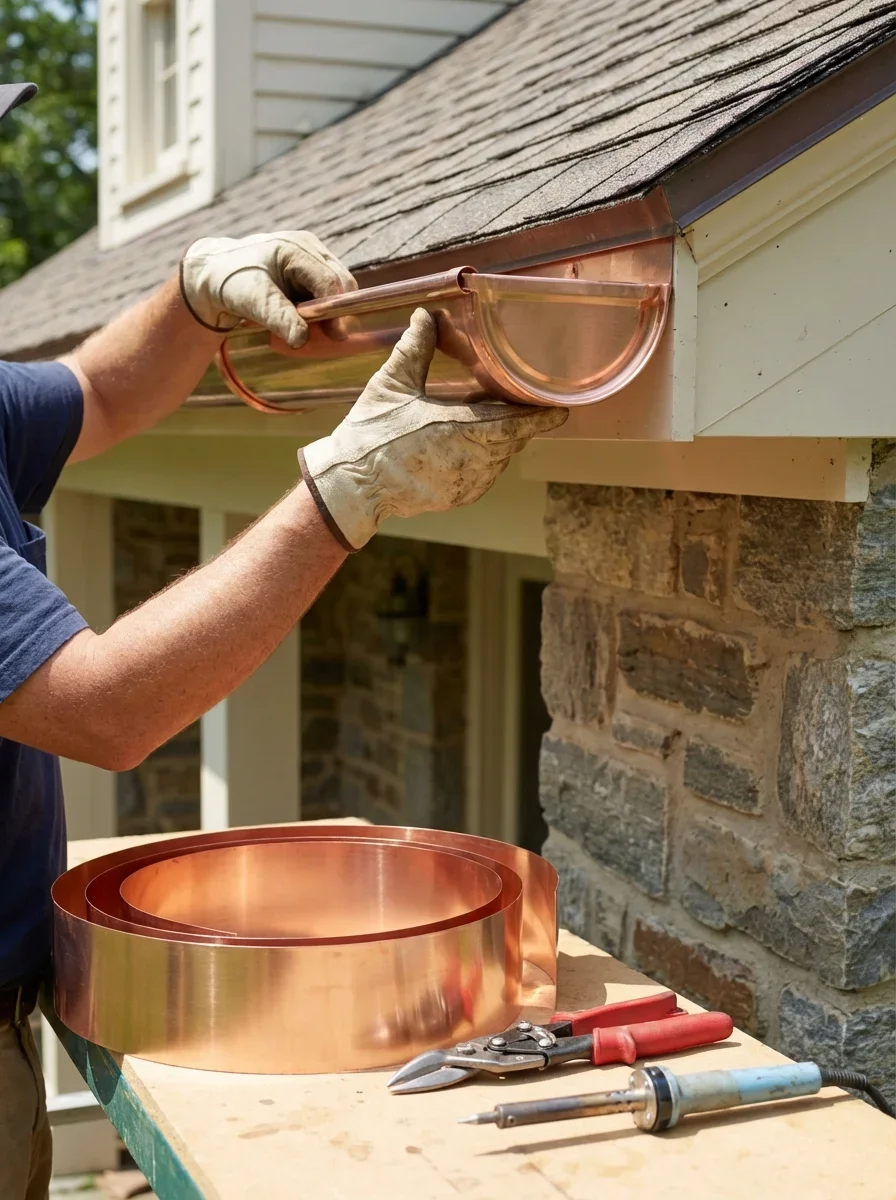
Half-round gutters are exactly what the name suggests: a semi-circular trough rather than the box-like K-style profile you see on most modern homes. Contractors install them with external brackets that cradle the bottom curve, leaving the gutter body exposed.
This design dates back centuries and remains the standard for period-accurate restoration work.
The profile matters beyond aesthetics. Half-round gutters shed debris more efficiently than K-style systems because they lack flat bottoms where leaves and sediment accumulate. Water flows smoothly through the curve, reducing standing moisture that accelerates corrosion in lesser materials.
When fabricated in copper, this profile complements traditional architecture—Colonial, Victorian, Craftsman, and Tudor styles—where visible gutters are part of the design language.
You'll find half-round systems in various widths, typically 5 to 7 inches in diameter. Contractors size them based on roof square footage and local rainfall intensity, just like standard gutters. The installation requires specialized brackets and hangers, which adds to both material cost and labor time compared to hidden-hanger K-style systems.
When Contractors Recommend Premium Gutter Materials
Copper makes practical sense when your home's expected lifespan matches the material's durability. If you're renovating a century-old house you plan to pass down through generations, copper aligns with that timeline.
Contractors also recommend it for high-visibility facades where gutters significantly impact curb appeal—think street-facing gables or prominent rooflines visible from main roads.
Historic district guidelines sometimes mandate copper or half-round profiles to maintain architectural authenticity. In those cases, you're not choosing premium materials for status—they're a compliance requirement.
Similarly, coastal properties benefit from copper's salt-air resistance, preventing the accelerated corrosion that destroys aluminum systems within a decade near oceans or large lakes.
Budget-conscious homeowners should understand that copper rarely pays for itself through maintenance savings alone within a typical ownership period. The value proposition centers on aesthetics, architectural appropriateness, and avoiding future replacement projects.
If you're planning to sell within 10 years, aluminum likely delivers better ROI. If you're settling in for the long haul, copper becomes part of the home's permanent infrastructure.
Copper Gutters Make Practical Sense When:
- Your home is in a historic district with architectural compliance requirements
- You're renovating a heritage property for multi-generational ownership
- The property is located in coastal or high-humidity environments
- Gutters are highly visible and significantly impact curb appeal
- You want to avoid repeat replacement projects over 50+ years
- Budget allows for long-term infrastructure investment rather than short-term ROI
How Copper Gutter Installation Differs from Standard Systems
Copper demands installation practices that aluminum doesn't require.
Thermal expansion tops the list—copper expands and contracts more dramatically with temperature swings than other gutter materials. Contractors must install expansion joints at 48-foot intervals to prevent buckling during summer heat or stress fractures during winter cold.[1] Miss this detail, and your premium gutters will develop waves and gaps within the first year.
Joining methods also separate copper from standard systems. Where aluminum uses crimped seams or pop rivets, copper installations traditionally employ soldered joints for watertight connections.
This requires propane torches, flux, and solder skills that general handymen don't typically possess. Some modern installers use concealed screws with sealant, but soldered joints remain the gold standard for longevity and leak prevention.
Fastening presents another complexity. Copper's weight—roughly twice that of equivalent aluminum—requires brackets spaced closer together, usually every 24 inches rather than 36. Contractors familiar with copper know to use copper or stainless steel fasteners exclusively; mixing metals creates galvanic corrosion that deteriorates both the gutter and mounting hardware.
The slope requirement of 1/8 inch per foot ensures proper drainage while accommodating expansion.[1]
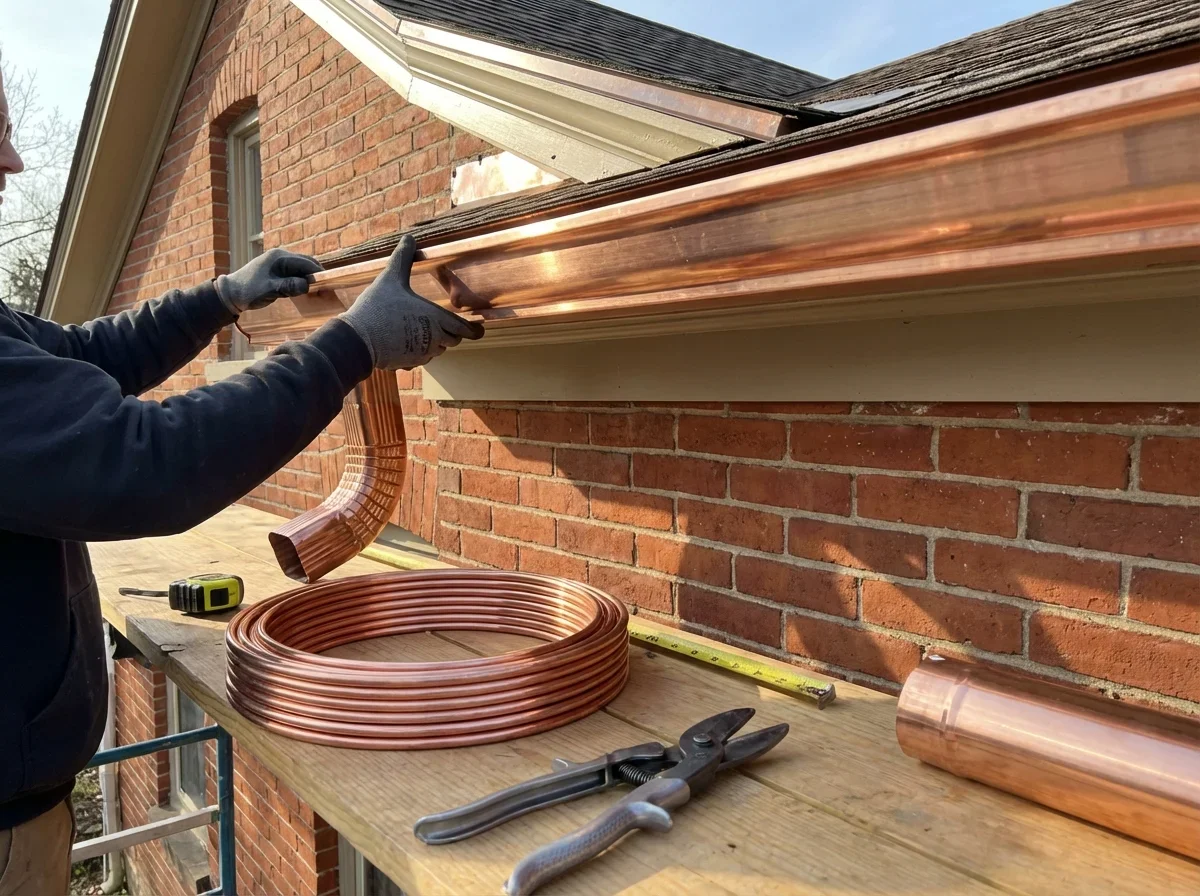
Rain Chains as Alternative Downspouts
Rain chains replace traditional downspouts with decorative metal chains or linked cups that guide water from gutter outlets to ground level. Originally a Japanese architectural element, they've gained popularity among homeowners seeking visual interest and the sound of flowing water.
Contractors often integrate them with copper gutter systems because the materials complement each other aesthetically—both develop patina and suit similar architectural styles.
Installation involves removing the downspout and securing a chain or cup system to the gutter outlet with a specialized adapter. The chain hangs vertically, and water follows the links downward through surface tension and gravity.
You'll need a splash block or catchment basin at ground level to direct water away from your foundation, just as you would with conventional downspouts.
Rain chains work best in moderate rainfall climates. During heavy storms, they handle less volume than 3-inch downspouts—water can spray off the chain rather than following it down.
Contractors typically limit rain chain use to locations where gutter overflow won't threaten basements or foundation walls. They're popular choices for covered porches, courtyard corners, or side elevations where you can enjoy the visual effect without risking water damage during severe weather.
What Do Copper Gutters Cost?
Copper gutter material alone runs $15 to $30 per linear foot for the gutter itself, before you factor in downspouts, brackets, end caps, and corner pieces.
Compare that to $3 to $8 per foot for aluminum. Installation labor adds another $10 to $20 per foot for standard configurations, but copper's specialized requirements often push total installed costs to $40 to $60 per linear foot for complete systems.[2]
A typical 150-foot residential installation—covering front, back, and two sides—lands between $6,000 and $9,000 for copper versus $1,200 to $2,500 for aluminum. Half-round profiles cost slightly more than K-style due to bracket complexity and fewer installers who stock the materials. Soldered joints add labor time, and homes requiring multiple expansion joints see further price increases.
The premium extends to accessories. Copper downspouts cost $12 to $20 per linear foot installed. If you're adding rain chains, expect $100 to $300 per chain depending on design intricacy.
Specialty items like scuppers, collector boxes, or custom conductor heads can add hundreds more. Experienced installers emphasize that cutting corners on proper brackets or skipping expansion joints to save $500 upfront typically costs far more in repairs within five years.[3]
Pro Tip: When comparing quotes, installers who don't itemize expansion joints, specialized brackets, and proper copper/stainless fasteners may be underestimating the job. These "forgotten" details often lead to change orders mid-project or premature system failure. Always verify that estimates include all copper-specific installation requirements.
Finding Contractors Who Specialize in Premium Gutters
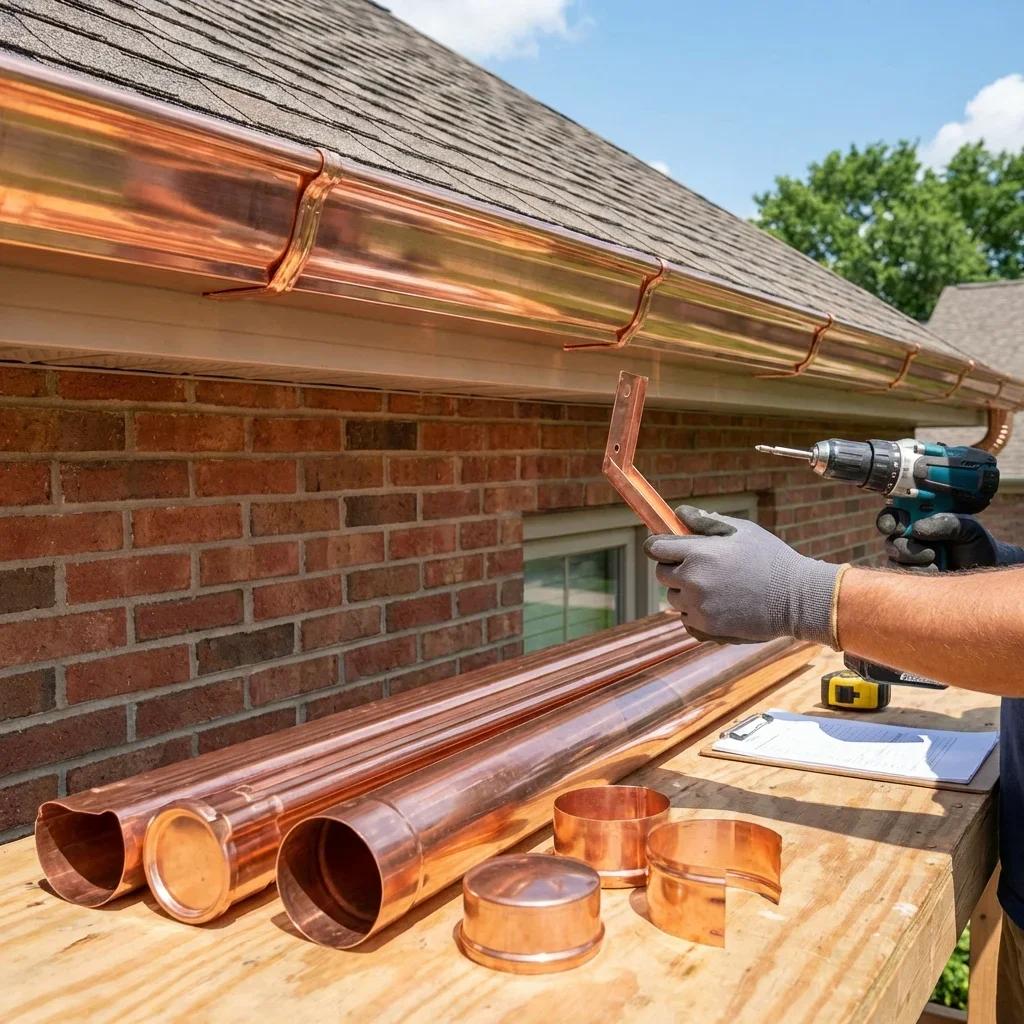
Not every gutter installer works with copper—the skills don't transfer directly from aluminum seamless machine operations. You need contractors who maintain soldering equipment, understand thermal expansion calculations, and regularly source copper materials.
Start by asking how many copper installations they complete annually. If the answer is "one or two," you're likely talking to a generalist who'll learn on your project.
Request photos of completed copper jobs, focusing on joint quality and bracket placement. Well-executed soldered seams appear smooth with minimal excess solder visible. Brackets should be evenly spaced and properly aligned with fascia boards.
Ask about their expansion joint strategy—installers who don't immediately reference the 48-foot rule from architectural specifications should raise concerns.[1]
Check whether they carry specialized insurance coverage for premium materials. Copper represents a significant material investment before installation begins, and you want protection if something goes wrong during the job.
Contractors experienced with copper also understand lead times—copper gutters aren't typically stocked at big-box stores. Ordering, fabrication, and delivery often take three to six weeks, which impacts project scheduling.
Compare Contractors Who Install Copper Systems
Get detailed written estimates that separate material costs from labor charges. This transparency lets you verify that contractors are quoting genuine copper rather than copper-colored aluminum, which some less scrupulous installers substitute while charging premium prices.
Specifications should list copper weight (16 or 20 ounce), profile type (half-round or K-style), and joinery method (soldered, mechanically fastened, or combination).
Ask each contractor about warranty coverage. Quality installers typically offer 10 to 20 year workmanship warranties on copper installations, backed by the material's inherent 50-plus year lifespan.
Be wary of contractors who won't warranty copper work beyond five years—it suggests they're uncertain about their installation quality or lack experience with the material's long-term behavior.
Discuss maintenance expectations upfront. Copper requires virtually no upkeep beyond periodic cleaning to remove debris, but some homeowners want specific guidance on patina preservation or polishing schedules. Contractors who've worked with copper extensively can advise whether sealants make sense for your climate and aesthetic preferences, or whether letting natural patina develop serves you better.
Frequently Asked Questions
- Copper Development Association. "Architectural Specifications - Copper Gutters and Downspouts." https://www.copper.org/applications/architecture/arch_dhb/specifications/arch_specs/gutters_downspouts.html. Accessed February 08, 2026.