
What Are DIY Gutter Guards and Who Sells Them?
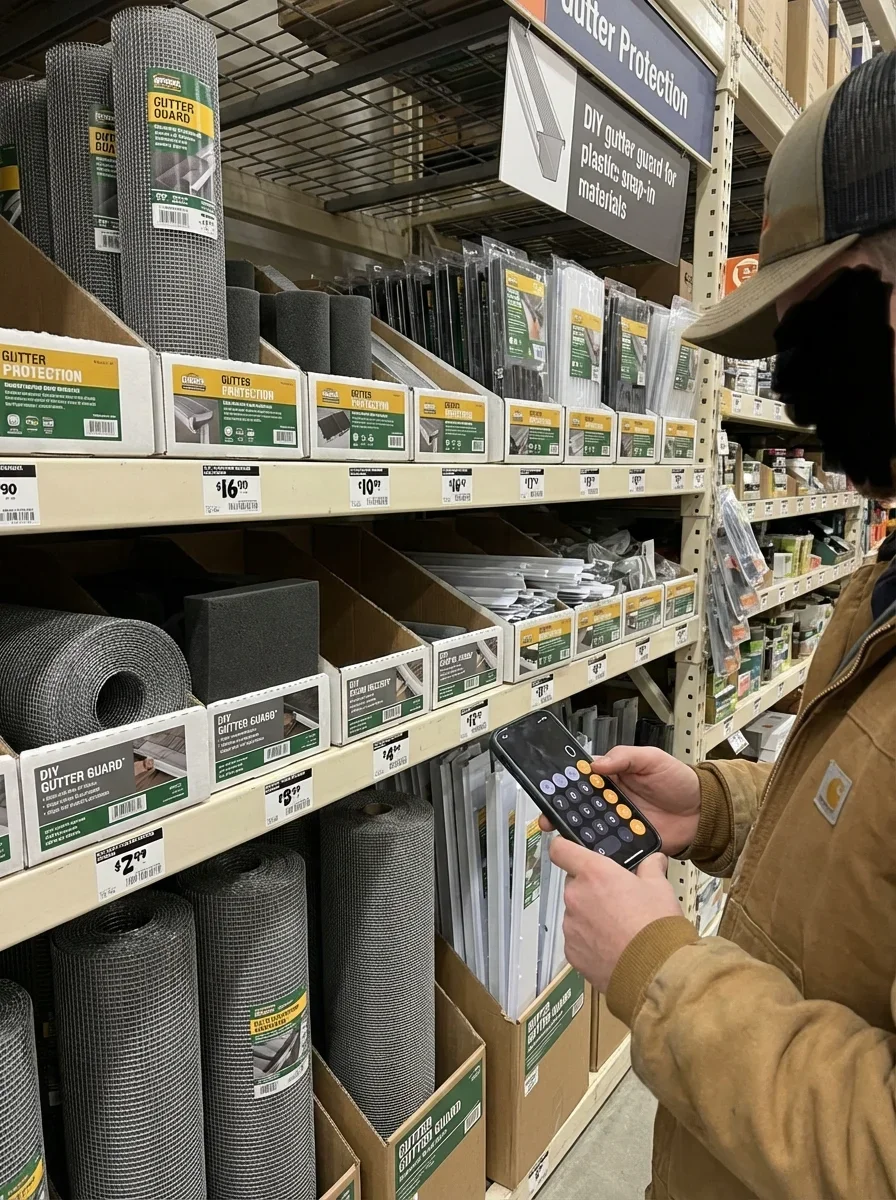
DIY gutter guards are the products you'll find at Home Depot, Lowe's, and Amazon — clip-on mesh screens, expandable foam inserts, and snap-together plastic panels. They're designed for homeowners to install without special tools, which means they rely on friction-fit clips, adhesive strips, or simply wedging into place under the first row of shingles.
The most common types are vinyl or aluminum mesh screens that clip onto your gutter lip, foam inserts that fill the gutter channel, and brush-style guards that sit in the gutter like a bottlebrush. All three share the same selling point: no professional installation required.
They also share the same weakness — they're not designed to integrate with your roof system, just sit on top of your gutters.
| DIY Guard Type | Cost per Foot | Lifespan | Primary Weakness |
|---|---|---|---|
| Mesh Screens | $1–$2 | 2–3 years | Clips loosen, warping from temperature changes |
| Foam Inserts | $1.50–$3 | 1–2 years | Absorbs debris/moisture, becomes sludge-filled |
| Brush Guards | $2–$3 | 2–4 years | Debris collects in bristles, requires frequent cleaning |
| Professional Guards | $7–$15 | 15–25 years | Higher upfront cost |
These products typically cost $1 to $3 per linear foot for materials. For a typical 150-foot gutter system, you're looking at $150 to $450 in supplies. That's the number that makes DIY attractive, but it's only the beginning of the real cost story.
Why Most DIY Gutter Guard Installations Fail
The average DIY gutter guard installation starts showing problems within 18 to 24 months. Water overshoots the gutter during heavy rain, screens warp and pull away from the gutter edge, and debris builds up on top instead of shedding off.
These aren't flukes — they're predictable outcomes of how these systems attach and interact with water flow.
Attachment Method Problems
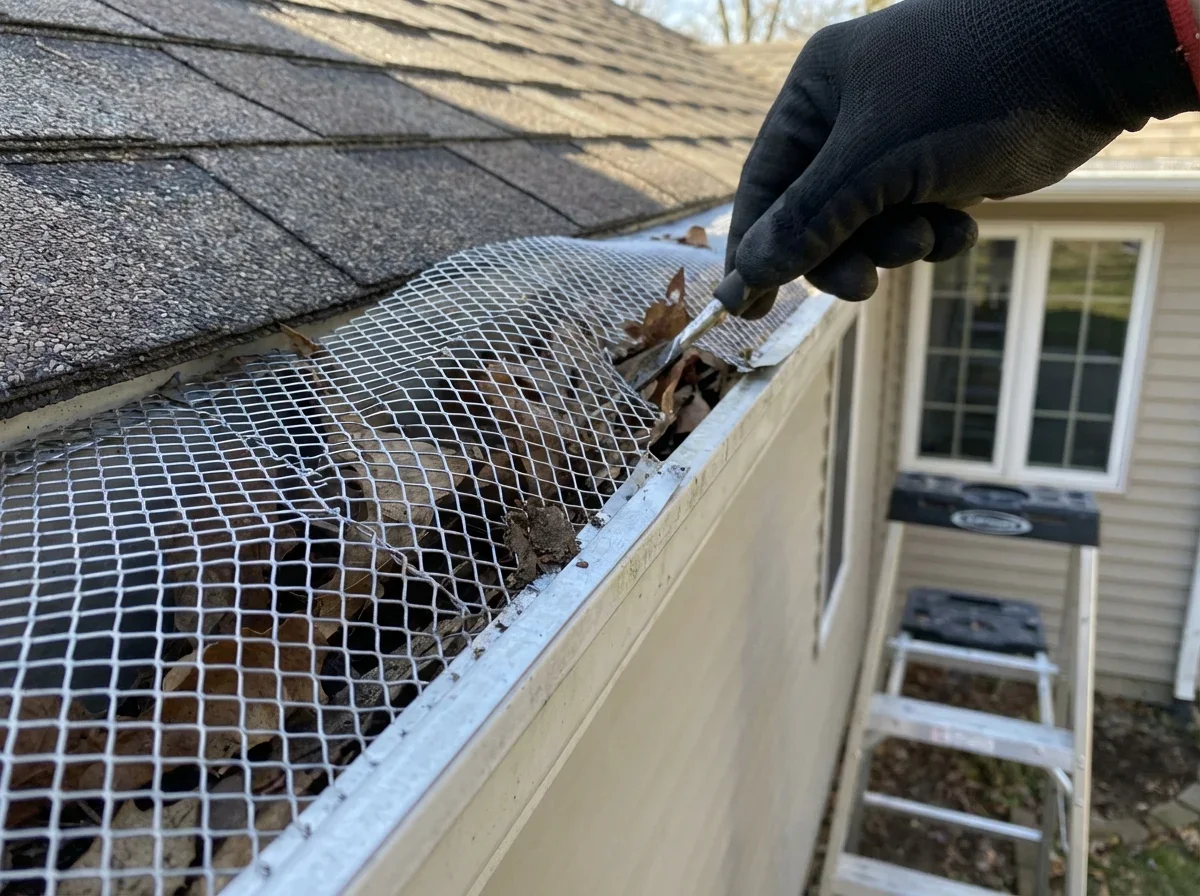
Clip-on guards rely on plastic or metal clips that hook over the gutter lip. Over time, thermal expansion and contraction loosen these connections. The clips warp in summer heat, become brittle in winter cold, and gradually lose their grip. When a section pulls away, it creates a gap where leaves and shingle grit accumulate.
Foam inserts present a different problem.
They're designed to fill the gutter and let water soak through while blocking debris. In practice, decomposing organic matter turns the foam into a sponge full of sludge. Tree seeds sprout in the trapped moisture. Homeowners often discover they've created a horizontal garden bed that weighs down their gutters and blocks water flow entirely.
Guards that slide under shingles without proper attachment damage your roof. They lift shingle edges, break sealant bonds, and create entry points for wind-driven rain. One homeowner described removing DIY guards after noticing ceiling stains — the lifted shingles had allowed water to wick into the roof deck for months.
Water Flow Issues and Overshooting
DIY guards typically sit flat across the gutter opening or slope at whatever angle your gutter naturally has. During heavy rainfall, water hits these flat surfaces and often shoots right over the gutter instead of flowing through the mesh or around the guard nose.
This is called overshooting, and it defeats the entire purpose of having gutters.
Professional guards are installed at a specific angle calculated for your roof pitch and rainfall intensity. Water needs to slow down and redirect into the gutter opening, not ricochet off a flat screen. DIY products can't account for these variables because they're one-size-fits-all solutions installed by people who don't calculate water velocity off a roof.
The water that overshoots your DIY guards lands right next to your foundation, exactly where gutters are supposed to prevent it from going. You'll see erosion channels in mulch beds, soil settling near the foundation, and in worst cases, basement seepage. You installed gutter guards to reduce maintenance, but you've created a drainage problem that's harder to spot and more expensive to fix.
Roof Damage from Improper Installation
Sliding DIY guards under shingles seems logical — that's how they stay in place. But shingles aren't designed to be lifted after installation. The sealant strip that bonds each shingle to the one below it breaks when you lift the edge.
Once broken, that bond doesn't reseal reliably, especially on roofs more than a few years old.
Homeowners often discover this damage when they remove failing DIY guards. The shingle edges are cracked, the sealant is compromised, and now they need roofing repairs on top of gutter guard replacement. Professional installers know how to integrate guards without breaking shingle seals, or they know when a roof is too old to safely accommodate certain guard styles.
Improper installation also voids roof warranties. If lifting shingles to install DIY guards leads to leaks, your roofing manufacturer and installer will rightfully deny coverage.
You've modified the roof system without following proper procedures.
The Hidden Costs of DIY Gutter Guard Installation
The $300 you saved on installation starts looking less attractive when you factor in what DIY really costs over time. Beyond the obvious expenses of replacing failed guards, there are safety risks, potential property damage, and the value of your time spent on repeat installations.
Safety Reality Check: Falls from ladders during gutter work send thousands of homeowners to emergency rooms annually. Your homeowner's insurance may classify DIY roof access as contractor-level activity — meaning coverage for injuries isn't guaranteed. One fall that causes you to miss two weeks of work costs more than five professional installations through lost wages alone.
Ladder Safety and Insurance Considerations
Working on gutters means working on ladders, often at heights of 20 feet or more for two-story homes. The U.S. Occupational Safety and Health Administration documents that improper ladder setup and use during gutter and roof access leads to falls — ladders must be secured at the proper 4:1 angle ratio and users must maintain three-point contact.[1][2]
One moment of imbalance while reaching to clip a guard into place and you're facing medical bills and lost work time.
Your homeowner's insurance may not fully cover injuries from DIY roof and gutter work. Some policies classify this as contractor-level activity. If you fall and can't work for months, you're dealing with medical costs, income loss, and the irony that hiring a professional would have cost less than your deductible.
Professional installers carry liability insurance and workers' compensation. If someone falls during a professional installation, their insurance handles it.
If you fall during your DIY project, your insurance handles it — maybe, after questions about whether you were engaging in excluded activities.
Replacement Cycles and Long-Term Expenses
DIY gutter guards rarely last beyond their second winter. Homeowners report that the first year looks promising, the second year shows deterioration, and by year three they're shopping for replacements.
At $300 per installation for materials and a full weekend of work, you're looking at $900 and three weekends over six years — before you count the cost of any damage from overshooting water or detached sections.
Professional installations typically carry 10 to 25-year warranties on both materials and workmanship. A single $1,500 to $2,000 professional installation that lasts 20 years costs less per year than DIY guards you replace every two to three years. This is before factoring in your labor time, which has real value even if you're not invoicing yourself.
There's also the cascading cost of DIY failure. Overshooting water damages fascia boards, which rot and need replacement before new guards can be properly installed. Some homeowners end up replacing gutters entirely because DIY guards trapped moisture against the metal and accelerated corrosion.
What started as saving $1,200 on installation becomes $3,000 in gutter and fascia replacement.
What Professional Installers Do Differently
Professional gutter guard installation isn't just a faster version of the DIY process. Contractors use different products, different attachment methods, and different integration techniques that homeowners can't replicate with big-box supplies.
Commercial-grade guards are custom-fabricated to your gutter dimensions and roof pitch. They're not universal-fit products designed to work on any house — they're measured, cut, and formed for your specific installation.
The aluminum is thicker, the mesh is finer, and the attachment systems are engineered for permanent installation rather than homeowner-friendly clips.
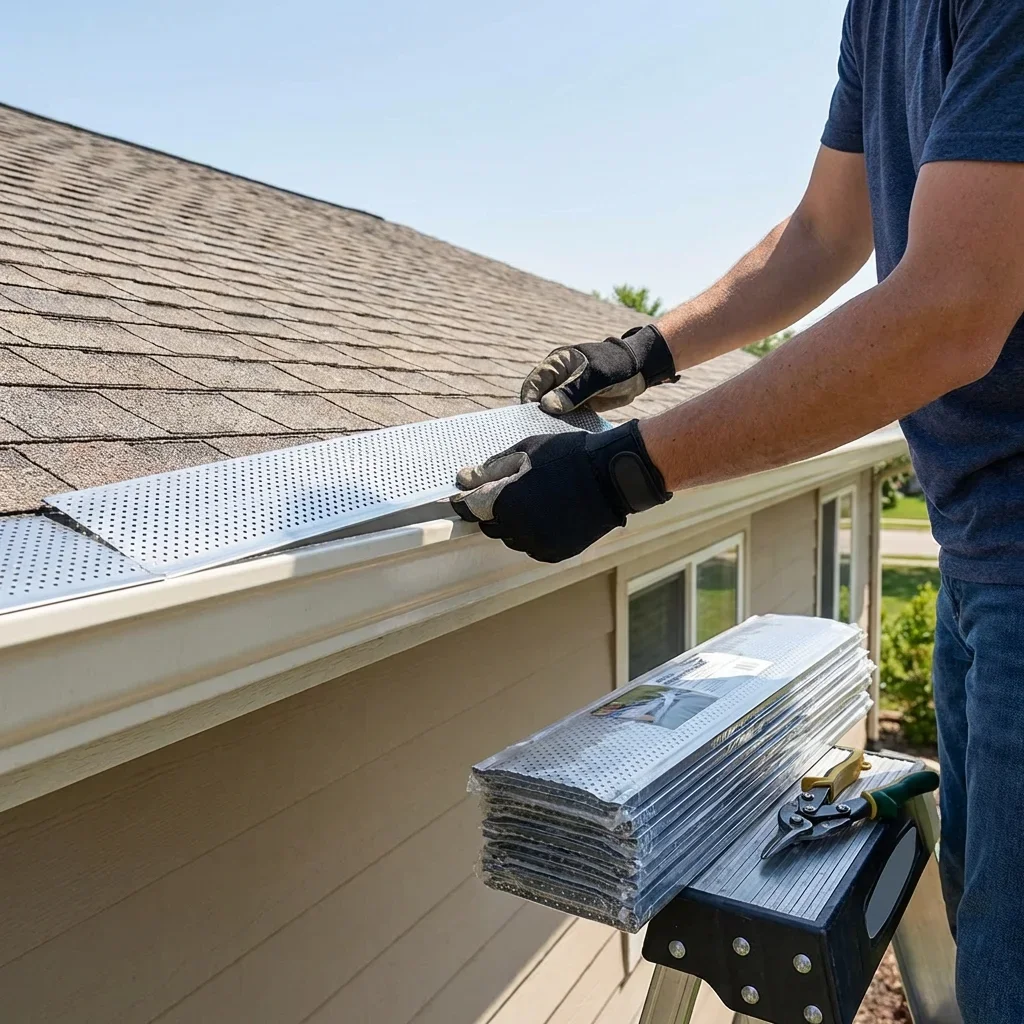
Professional installers secure guards under shingles using proper roofing techniques. They lift shingles carefully, use sealant to re-bond edges, and ensure water still flows correctly off the roof edge. On roofs where lifting shingles risks damage, they use alternative mounting methods that attach to fascia or gutter fronts with hidden fasteners. These aren't options available to DIYers with retail products.
The angle and pitch of professional guards are calculated for water flow. Contractors measure your roof pitch, evaluate typical rainfall intensity for your region, and set guard angles that slow water enough to redirect it into the gutter without overshooting.
This often means the front edge sits slightly lower than the back edge, creating a surface that guides water rather than deflecting it.
Pros also understand that effective guards must integrate properly with your entire roof drainage system[3], not just sit on top of gutters. They evaluate downspout capacity, check for proper gutter slope, and sometimes recommend system modifications before installing guards. A DIYer installs guards on whatever gutter system exists.
A professional makes sure that system works first.
When DIY Gutter Guards Actually Make Sense
There are situations where DIY gutter guard installation is reasonable. These are rare and specific, but they exist.
If your circumstances match these criteria, a well-executed DIY installation might serve you adequately.
Single-story ranch homes with minimal roof pitch are the best candidates for DIY guards. You can reach the gutters from a stable ladder position, the fall risk is lower, and water flow dynamics are simpler on low-slope roofs. If your lot has minimal tree coverage — meaning you're installing guards for occasional leaf drop rather than constant debris — simple mesh screens might suffice.
Screen-style guards are the most DIY-friendly option. They clip onto gutter lips without requiring shingle work, they're visible for inspection and maintenance, and they're easy to remove and replace as needed.
If you understand you're installing a temporary or semi-permanent solution that you'll likely replace in three to five years, and you're comfortable with that trade-off, DIY screens can reduce maintenance frequency without major risk.
Rental properties where you're managing costs on a tight budget sometimes justify DIY installation. If you're in a property for a few years before selling, and you need functional gutter protection without investing in a permanent solution, DIY guards can bridge the gap.
Just be honest with future buyers about what's installed — don't present DIY guards as equivalent to professional systems.
Beyond these scenarios, professional installation becomes the better choice. Two-story homes, steep roofs, heavy tree coverage, or locations with intense rainfall all push the odds against DIY success.
The more complex your situation, the more likely DIY guards will fail in ways that cost more to fix than professional installation would have cost in the first place.
True Cost Comparison: DIY vs Professional Over 10 Years
Let's look at real numbers over a decade. This isn't about which option is cheaper right now — it's about which option costs less when you count all the consequences.
10-Year Cost Breakdown:
DIY Total: $2,000+ minimum (not including labor value)
- $300 materials × 4 reinstallations = $1,200
- 64 hours of labor across installations
- $800 fascia repair from water damage (year 5)
- Risk of additional repairs from system failures
Professional Total: $1,800 one-time cost
- Full-system installation with commercial-grade guards
- 15-year warranty on materials and workmanship
- Zero reinstallation costs during 10-year period
- Included call-back service for adjustments
DIY approach: $300 in materials and supplies per installation. Assuming replacement every 2.5 years due to failure or deterioration, that's four installations over 10 years at $1,200 in materials. Add 16 hours of labor per installation at 64 hours total — value that however you price your weekend time. Include one fascia repair at $800 after water damage from overshooting during year five.
Total: $2,000 minimum, not counting your time or any additional repairs from system failures.
Professional approach: $1,800 for full-system installation with commercial-grade guards, 15-year warranty on materials and workmanship. Zero reinstallation costs during the 10-year period. No fascia damage because proper water flow was maintained. Call-back service if any sections need adjustment.
Total: $1,800.
The professional installation saves money in this scenario, and that's before considering opportunity cost. Those 64 hours you spent on DIY installations over the decade could have been spent on anything else. The weekend you spent re-installing failing guards could have been a family trip.
Time has value even when you're not billing yourself.
This calculation assumes everything goes reasonably well with DIY — no falls, no major property damage, no gutter replacement. One serious problem tilts the economics dramatically toward professional installation.
The homeowner who falls off a ladder and misses two weeks of work has just paid for five professional installations through lost wages alone.
Find Professional Gutter Guard Installers in Your Area
Professional gutter guard installation typically costs $7 to $15 per linear foot including materials and labor. For a standard 150-foot system, expect quotes between $1,050 and $2,250.
Variables include your home's height, roof pitch, existing gutter condition, and the guard system you select.
Get at least three quotes from licensed contractors who specialize in gutter guards specifically, not general handyman services. Ask what products they install, how they attach guards to your roof type, and what their warranty covers. The installer should inspect your roof and gutters before quoting — anyone who gives a price over the phone without seeing your house is guessing.
Quality contractors will explain why they recommend specific products for your situation. Heavy tree coverage needs micro-mesh guards, not basic screens. Steep roofs require different attachment angles than low-slope ranches.
If a contractor doesn't ask about your tree coverage, roof age, or typical weather patterns, they're not analyzing your needs properly.
Frequently Asked Questions
- U.S. Occupational Safety and Health Administration (OSHA). "Ladder Safety." https://www.osha.gov/ladders. Accessed February 09, 2026.
- U.S. Occupational Safety and Health Administration (OSHA). "Steep Roofing." https://www.osha.gov/etools/construction/steep-roofing/ladders. Accessed February 09, 2026.
- Pennsylvania State University Extension. "Guarding Against Gutter Damage and Rot." https://extension.psu.edu/guarding-against-gutter-damage-and-rot. Accessed February 09, 2026.