
Do Gutter Guards Cause Ice Dams?
No. Gutter guards do not cause ice dams, but they can change where ice accumulates once a dam starts forming.
The confusion comes from homeowners who installed guards and then noticed ice buildup at the roof edge for the first time. What they're actually seeing is the ice dam itself — a problem that was always going to happen based on what's going on inside their attic, not what's covering their gutters.
Ice dams form on your roof, not in your gutters. The dam is a ridge of ice that builds up when heat escaping through your roof melts snow, which then refreezes at the colder eaves. Once that ridge forms, meltwater gets trapped behind it and can back up under shingles, causing leaks and interior damage.
Understanding How Ice Dams Actually Form
Ice dams are fundamentally an insulation and ventilation problem. When your attic is warmer than the outside air, that heat transfers through the roof deck and melts the bottom layer of snow.[1] The water runs down until it reaches the overhang — the part of your roof that extends past the exterior wall. That section stays cold because there's no heated space below it. The water refreezes there, slowly building a dam that blocks additional runoff.
The University of Minnesota Extension is blunt about this: ice dam prevention focuses on attic insulation, ventilation, and air sealing rather than gutters.[1]
Your gutters are downstream victims, not the source of the problem.
Key Insight: Gutter guards don't create ice dams — they just make existing ice dam problems more visible. The real culprit is heat escaping from your attic, not what's covering your gutters.
How Gutter Guards Interact with Winter Ice
Here's where guards enter the picture. Once an ice dam forms and meltwater starts backing up, some of that water will freeze on or around whatever's covering your gutters. Solid-surface guards (especially reverse-curve types) can develop a shelf of ice along the front edge. Homeowners see this ice curtain and assume the guards caused it.
What actually happened is the ice dam caused overflow, and the guard gave that overflow a place to freeze.
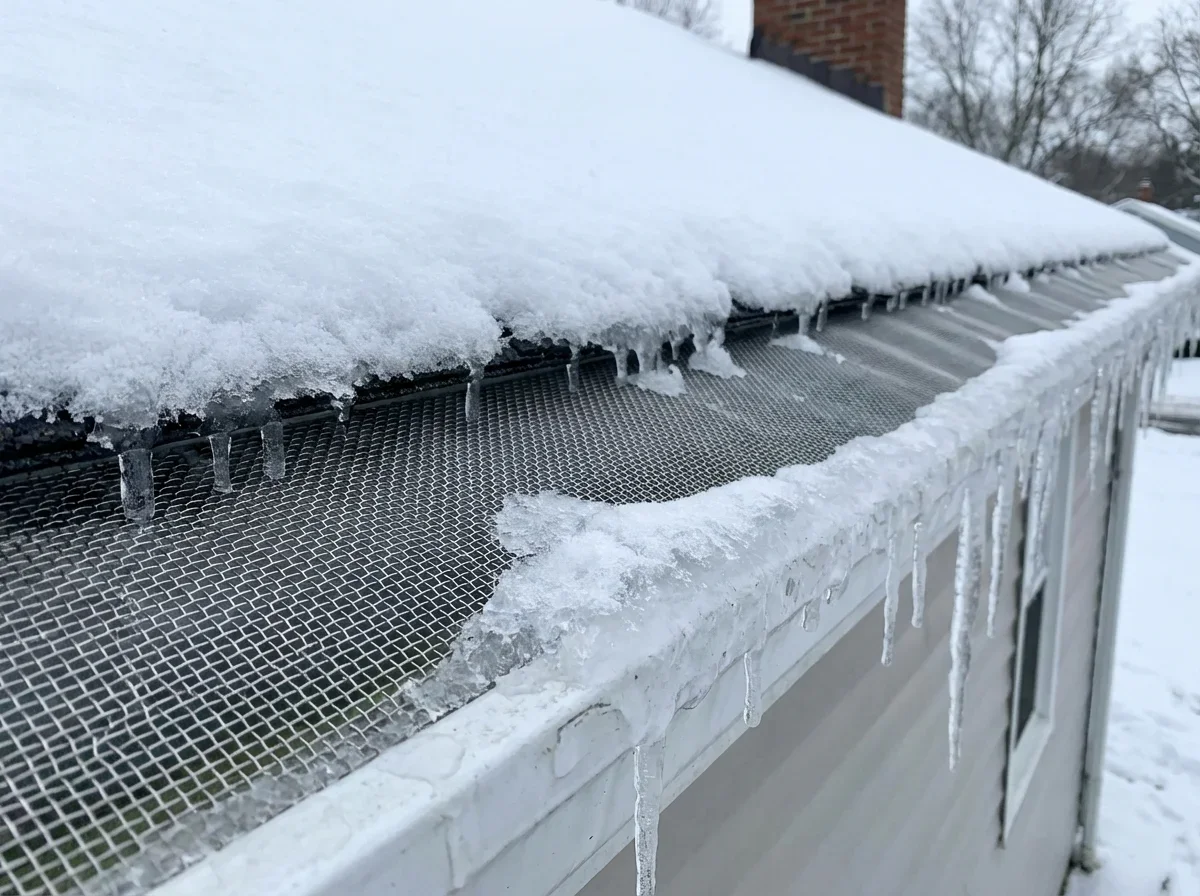
Screen and micro-mesh guards tend to trap ice differently. Snow can accumulate on top of the mesh, and repeated freeze-thaw cycles cause that snow to become dense ice sitting directly on the guard surface. If the mesh holes freeze shut, you've got a solid ice cap over your gutters. When the next thaw comes, water can't penetrate the ice layer and instead flows over it.
Neither scenario is ideal, but neither means the guard created the dam. You'd have the same ice dam without guards — you'd just see it manifest as gutters overflowing or pulling away from the fascia instead of ice formations on the guard surface.
How Different Gutter Guard Types Perform in Winter
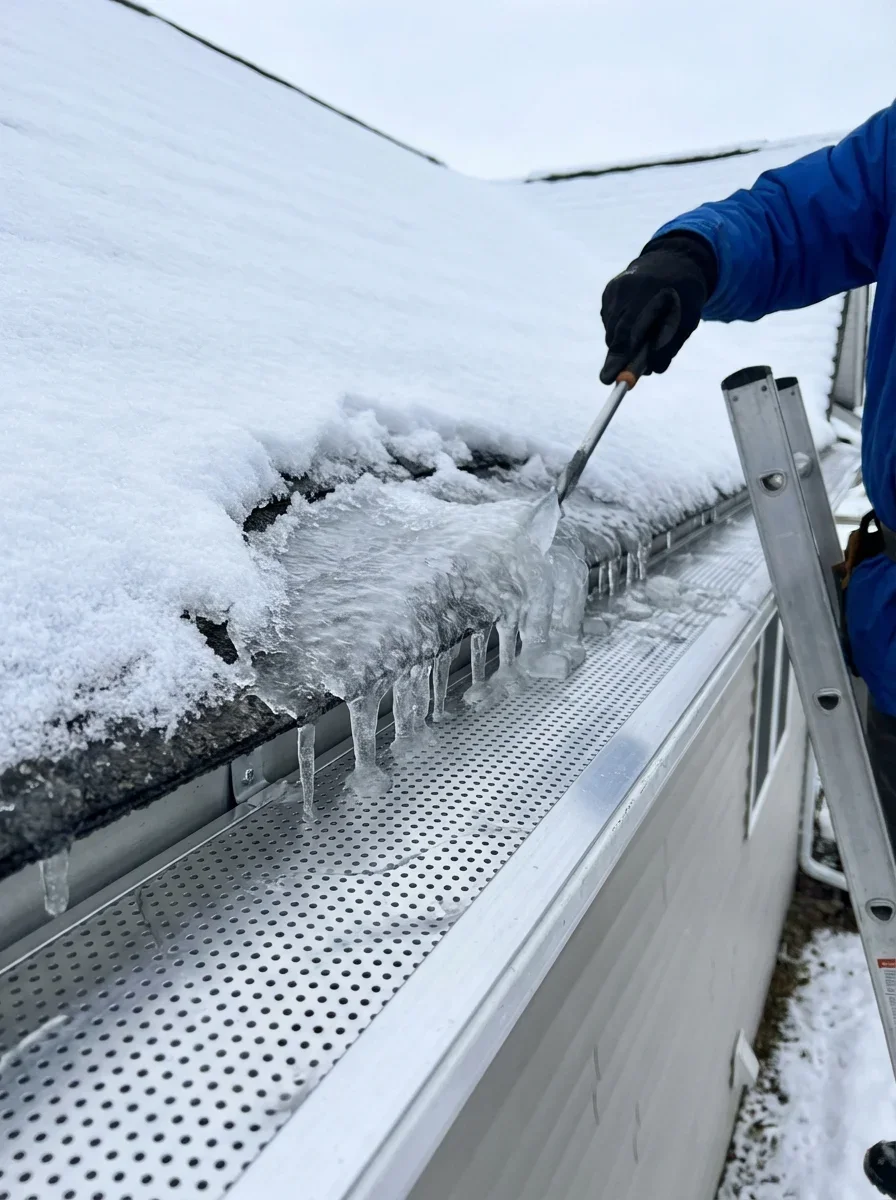
Not all guards handle Wisconsin winters the same way. The design that works great for keeping out leaves can become a liability when snow and ice enter the equation.
Screen Guards and Ice Buildup
Basic metal or plastic screen guards are the most vulnerable to winter problems. Snow sits directly on the screening, and when temperatures hover around freezing, that snow compacts into ice that fills the mesh openings. By mid-January, many screen guards are completely sealed over with a layer of ice.
The bigger issue is what happens during thaws. If the screen is frozen solid, meltwater can't drain through your gutters at all — it just sheets over the ice cap and freezes again at the gutter edge or drips behind the fascia. Some contractors in cold climates specifically avoid recommending screen-style guards for this reason, even though they're the cheapest option.
Reverse Curve and Micro-Mesh Systems
Reverse-curve guards (the type with a curved hood that directs water into a narrow slot) perform better in some ways and worse in others. They typically don't allow snow to accumulate on top because of the curved surface. But that same curve can create an extended lip where icicles form spectacularly.
If you've got an ice dam pushing water toward the edge, that water will run over the curve and freeze mid-air, creating impressive icicle formations that worry homeowners even when they're not causing structural damage.
High-quality micro-mesh systems generally handle winter conditions best, particularly surgical-grade stainless steel mesh with a mounting system that leaves a small gap between the guard and the shingles. That gap allows some air circulation that can help with minor freeze-thaw cycles. The ultra-fine mesh also means less surface area for snow to grip, so light dustings blow off rather than accumulating.
But even premium micro-mesh won't stop ice dams from forming if your attic is bleeding heat.
The metal conductivity matters too. Aluminum guards conduct cold efficiently, which means they ice up faster than stainless steel in the same conditions. Some homeowners with aluminum guards report needing to physically knock ice off the guards mid-winter, while those with stainless systems see less dramatic buildup.
| Guard Type | Winter Performance | Ice Accumulation Pattern | Best For |
|---|---|---|---|
| Screen Guards | Poor — mesh fills with compacted ice | Snow sits directly on surface, freezes solid | Mild climates only |
| Reverse Curve | Moderate — impressive icicles form | Ice shelf forms along curved lip | Homes without ice dam history |
| Micro-Mesh (Aluminum) | Good — but conducts cold quickly | Light buildup, requires occasional clearing | Budget-conscious cold climates |
| Micro-Mesh (Stainless) | Best — minimal ice grip, better airflow | Least accumulation, self-clearing in thaws | Wisconsin winters, ice dam-prone homes |
What Contractors Recommend for Ice Dam Prevention
Talk to experienced contractors in the Fox Valley, and you'll hear the same advice: fix your attic before you worry about your gutters.
Gutter guards are a maintenance solution, not a winter weatherproofing strategy.
The Real Solutions: Attic Insulation and Ventilation
The Insurance Institute for Business & Home Safety emphasizes that ice dams can be mitigated through proper attic ventilation, increased attic insulation, and sealed ceiling openings to reduce heat loss.[2] That means you need adequate insulation on your attic floor (R-49 to R-60 in Wisconsin), a continuous air barrier to prevent heated air from leaking into the attic, and sufficient ventilation to keep the attic temperature as close to outdoor temperature as possible.
Most ice dam problems trace back to recessed lights, bathroom exhaust fans, attic hatches, and other penetrations that let conditioned air into the attic space. Sealing those leaks makes more difference than any gutter product ever will.
Ridge and soffit vents should provide at least 1 square foot of ventilation per 150 square feet of attic space, with intake vents at the soffits and exhaust at the ridge to create proper airflow.
If you're installing gutter guards and you've had ice dam problems in the past, that's your signal to get an energy audit or have a contractor inspect your attic insulation and ventilation. Addressing both issues at once makes sense — you're already working on the roofline.
Ice Dam Prevention Checklist:
- Add attic insulation to R-49–R-60 minimum
- Seal recessed lights, exhaust fans, and attic hatches
- Install 1 sq ft ventilation per 150 sq ft attic space
- Ensure soffit intake vents are clear and unblocked
- Maintain proper ridge vent exhaust at roof peak
- Schedule energy audit to identify heat loss points
- Consider these before investing in gutter guards
When Heated Cables Make Sense
Heat cables (also called heat tape) are a band-aid solution that some homeowners swear by and others consider an expensive surrender. These electrical cables run along the roof edge and through gutters, melting channels through ice to maintain drainage. They don't prevent ice dams, but they can minimize damage by giving water an escape route.
Contractors generally recommend heated cables only for homes where insulation upgrades aren't feasible — buildings with cathedral ceilings, finished attics, or historic homes where you can't add ventilation without major renovation. The cables need to be installed in a zigzag pattern up the roof slope, not just in the gutters, to be effective.
And they'll add $20-50 to your monthly electric bill when they're running.
If you're considering guards and you already have heat cables, tell your installer upfront. Some guard systems can be installed to work with cables, while others block access or create hotspots where the cable contacts the guard material. A few premium manufacturers make guards with integrated heating elements, though these cost significantly more.
Gutter Snow Guards vs. Roof Snow Guards: What's the Difference?
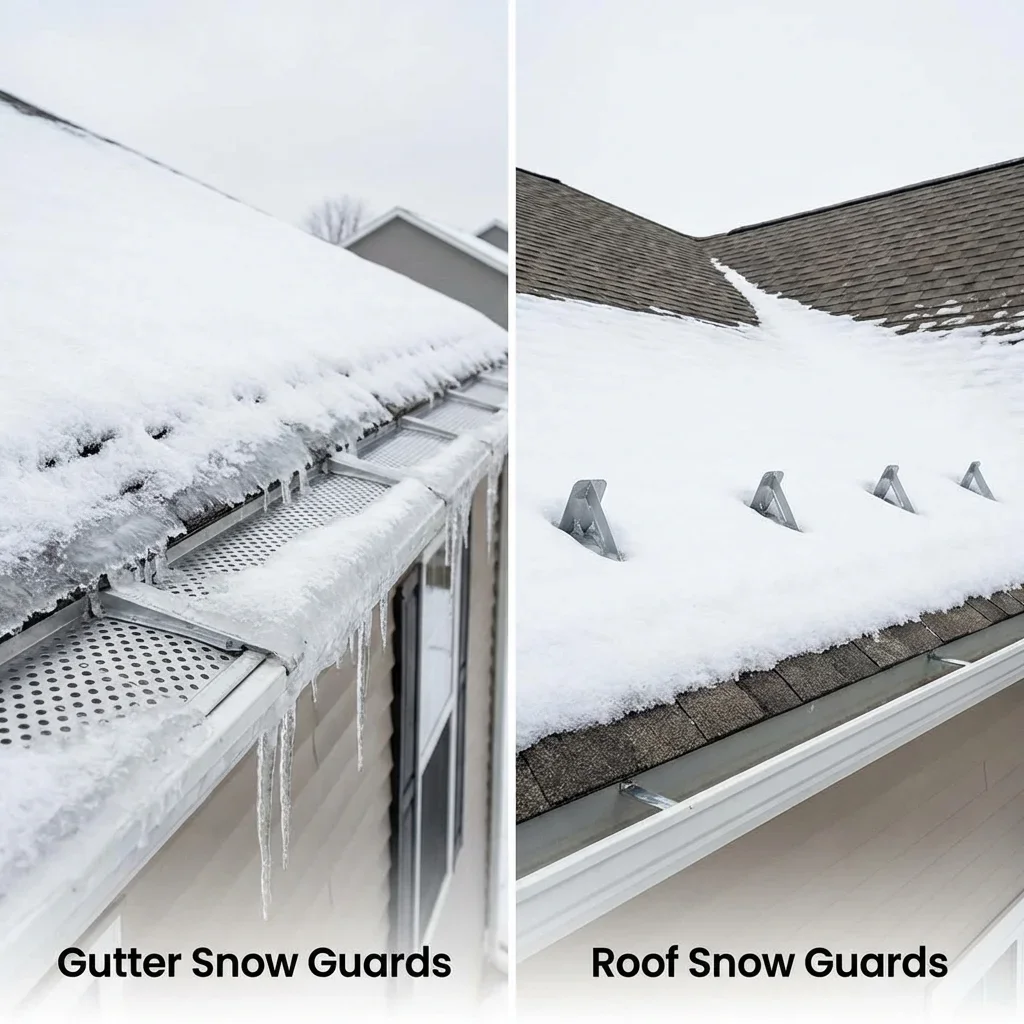
Here's where terminology trips people up. "Gutter snow guards" isn't a standard product category — most people searching for this term are looking for information about how gutter guards perform in snow, which we've covered.
But roof snow guards are a completely different animal.
Roof snow guards (sometimes called snow stops or snow rails) are small devices installed directly on your roof surface, usually in rows above vulnerable areas like walkways, decks, or lower roof sections. Their job is to hold snow on the roof and prevent sudden avalanches of sliding snow that could damage gutters, landscaping, or people below. They're particularly common on metal roofs, which shed snow rapidly, and on steep-pitched roofs where gravity wants to dump the entire snowpack at once.
These have nothing to do with gutter guards and won't help with ice dams. In fact, by holding snow on your roof longer, they can slightly increase ice dam risk if you've got heat loss issues.
But they're essential for preventing the kind of dramatic roof avalanche that can rip gutters clean off the house or injure someone standing below. If a contractor mentions snow guards during a gutter guard consultation, clarify which type they mean.
Find Contractors Who Understand Cold Climate Installation
Not every gutter guard installer thinks about winter performance, especially if they're using sales scripts developed for warmer climates. When you're getting quotes, ask specific questions that reveal whether the contractor understands Wisconsin conditions:
- "Have you installed this system on homes that had ice dam problems? What happened the following winter?"
- "What's the warranty coverage if ice damages the guards or the mounting system fails due to ice weight?"
- "Do you modify the installation angle or gap spacing for homes in northern climates?"
Good contractors will talk about attic ventilation during a gutter guard consultation. They'll look at your roofline and ask whether you've had ice dam issues before. They should be able to explain why their recommended system handles freeze-thaw cycles better than alternatives, with specifics about materials and mounting methods, not just marketing claims.
Be skeptical of anyone who promises guards will eliminate your ice dam problems.
That's either ignorance or dishonesty. Guards are part of your home's water management system, but ice dams are a heat management problem that lives in your attic. A contractor who understands that distinction is one who'll install guards that survive winter instead of making it worse.
The Fox Valley sees enough freeze-thaw cycles each winter to stress any roofline component. Your guards need to handle not just snow accumulation but the expansion and contraction that comes with temperature swings from 10°F to 40°F in a single week. Finding installers with track records on homes like yours — same age, same roof pitch, same insulation quality — gives you the best shot at a system that still looks good and functions well come March.
Frequently Asked Questions
- University of Minnesota Extension. "Dealing with and preventing ice dams." https://extension.umn.edu/protecting-home-rain-and-ice/dealing-and-preventing-ice-dams. Accessed February 08, 2026.
- Insurance Institute for Business & Home Safety (IBHS). "Ice Dams: Prevent Them and Your Roof Will Thank You." https://ibhs.org/ibhs-news-releases/ice-dams-prevent-them-and-your-roof-will-thank-you/. Accessed February 08, 2026.