
Why Are You Researching Gutter Sections?
Most homeowners end up searching for specific gutter lengths for one of two reasons: they're planning a DIY installation to save money, or they're trying to reverse-engineer what a contractor quoted them. Both are completely understandable impulses. Home improvement stores make it look straightforward — just buy sections, snap them together, hang them up.
The reality is more nuanced. Professional gutter installation isn't expensive because contractors are marking up materials by 300% — it's expensive because the materials are the easy part. The hard part is assessing your roof's water flow, calculating proper slope, mounting securely to aging fascia boards, and creating a system that won't leak or overflow during the first heavy rain.
Homeowners who've gone the DIY route with big-box gutter sections often find that joints leak despite careful installation, simply because they lack the specialized sealants and crimping tools that professionals use.[3][4]
If you're researching 20-foot sections specifically, you're probably dealing with a longer roofline and thinking fewer seams means fewer problems. That logic makes sense until you realize that even a single poorly sealed seam will drip right over your foundation, and that professional seamless gutters eliminate those joints entirely.
Standard Gutter Sizes and When to Use Each
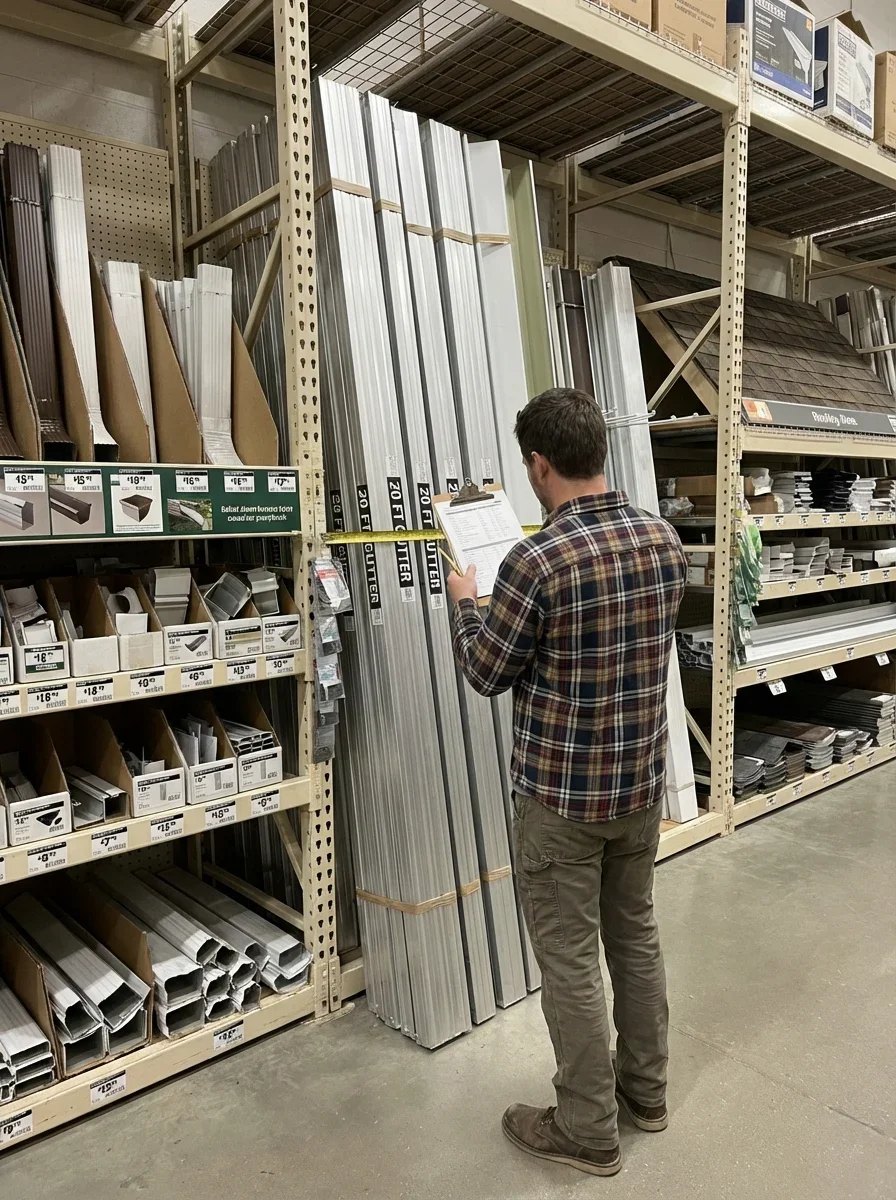
Before you worry about section lengths, you need the right gutter size for your roof. Contractors don't just eyeball this — they calculate based on your roof's square footage, pitch, and how water concentrates in valleys.
5-Inch vs 6-Inch K-Style Gutters
The standard residential gutter is 5-inch K-style, which handles most single-story homes and moderate roof areas just fine. It's what you'll find in those 20-foot sections at Home Depot, and it works for typical suburban houses with straightforward rooflines.
Most contractors default to 5-inch unless they see a reason to go bigger.
That reason is usually water volume. Steep roofs, large roof areas, or valleys that concentrate flow all dump more water than 5-inch gutters can handle during heavy storms. You'll see overflow at the gutters even though the downspouts aren't clogged — the gutter itself is just undersized for the job.
Six-inch gutters move roughly 50% more water, which sounds like overkill until you've watched a 5-inch system overflow during a thunderstorm. Contractors recommend them for two-story homes, roofs with limited downspout locations, or anywhere rainfall intensity exceeds what a smaller gutter can move.
The catch is that you won't find 6-inch sections sitting on a shelf — this is where professional fabrication starts making more sense than DIY.
| Feature | 5-Inch K-Style | 6-Inch K-Style |
|---|---|---|
| Best For | Single-story homes, moderate roof areas | Two-story homes, steep roofs, large surface areas |
| Water Capacity | Standard residential volume | 50% more than 5-inch |
| Availability | Readily available at Home Depot in 10-20 ft sections | Professional fabrication required |
| Typical Cost | $5-8 per linear foot (materials) | $8-12 per linear foot (installed) |
Sectional vs Seamless Gutter Systems
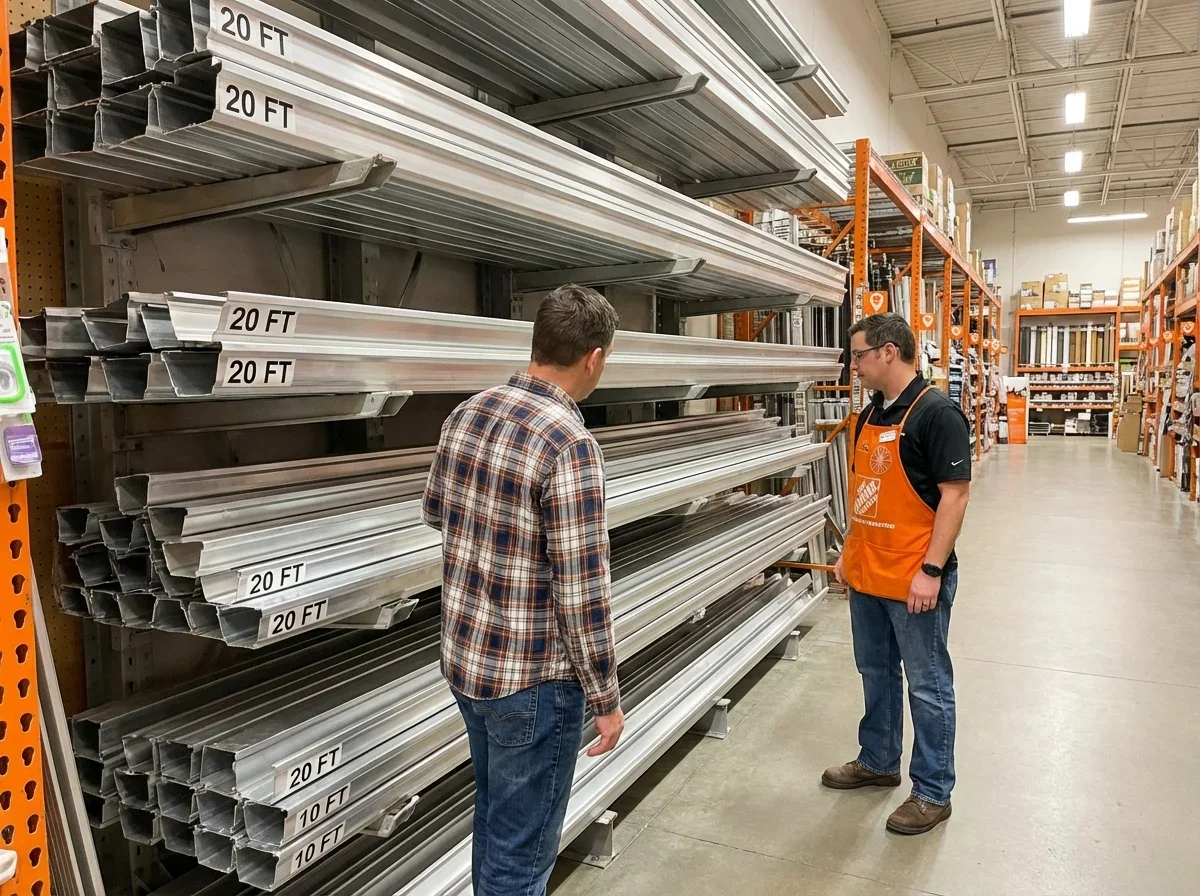
Walk into any home improvement store and you'll see 10-foot and 20-foot gutter sections in various materials. They're appealingly simple — pre-formed, ready to install, priced clearly on the shelf. This is sectional guttering, and it's been the homeowner go-to for decades.
But there's a reason most professional gutter companies don't install sectional systems anymore: every joint is a future leak.
You connect sections with specialized brackets and seal them with gutter caulk, and if you do everything perfectly, it'll hold for a while. When homeowners install these themselves, though, they often discover that their carefully assembled system starts dripping at the seams within the first year, particularly where sections meet at corners or around downspout outlets.[3][4]
The problem isn't the sections themselves — it's that water finds any imperfection. Temperature changes expand and contract the metal slightly. Thermal cycling breaks down even professional-grade sealants over time. Add in the stress from ladders leaning against gutters, occasional ice dams, and the inevitable debris buildup, and those seams become the weak point in your entire system.
Why Contractors Recommend Seamless
Seamless gutters solve the leak problem by eliminating it. Contractors bring a roll-forming machine to your house and fabricate gutters in whatever custom length your roofline needs — 20 feet, 35 feet, 50 feet, whatever matches the run.
The only seams are at inside and outside corners where they're unavoidable, and even those get professionally mitered and sealed.
This isn't just about preventing leaks. Seamless systems let contractors design proper water flow without being constrained by 10-foot or 20-foot increments. They can calculate the ideal starting point, set a consistent slope across the entire run, and place downspouts exactly where drainage makes sense — not where section lengths happen to line up. Homeowners who've dealt with overflow issues in valleys or along complex rooflines often find that the problem wasn't maintenance or debris, it was a system design that never accounted for how water moves across their specific roof.[5]
The cost difference between sectional materials and professional seamless installation is smaller than most people expect. You might spend $300-500 on Home Depot sections, hangers, end caps, outlets, corners, downspouts, and sealant for a typical roofline. Professional seamless installation runs $800-1,500 for the same house, but that includes proper fascia assessment, accurate pitch calculation, commercial-grade hangers every 24 inches, and a system that's warrantied against leaks.
When DIYers factor in their time, tool rentals, and the inevitable second trip to the store for forgotten pieces, that gap narrows considerably.
Gutter Materials: What Contractors Use
Home Depot stocks aluminum gutter sections in various lengths because aluminum hits the sweet spot of affordability, workability, and durability for most climates. You'll typically find .027 or .032 gauge aluminum, which is thin enough to cut with aviation snips but thick enough to hold its shape under normal conditions.
Professional contractors often work with .032 gauge as their standard, sometimes stepping up to .040 gauge in areas with heavy snow loads or where the fascia mounting might be questionable. Thicker aluminum costs more but resists denting from ladders and holds screws more securely in the long term. It's not a dramatic difference — we're talking about metal thickness measured in thousandths of an inch — but it matters when you're engineering something that needs to last 20 years.
Copper gutters are what you'll see on historic homes and high-end renovations. Contractors who work with copper are typically specialists because the material requires different tools, fasteners, and soldering techniques. Copper develops that green patina over time, which some homeowners love and others hate, but the material itself will outlast aluminum by decades.
The cost is roughly triple what aluminum runs, which puts it out of reach for most residential budgets.
Steel (usually galvanized) shows up occasionally in areas with extreme weather or where impact resistance matters more than weight. It's heavier than aluminum, which means more robust fascia mounting, and it will rust eventually if the galvanized coating gets scratched. Most contractors stick with aluminum unless there's a specific reason to deviate.
The gauge thickness and material choice matter more than the length of sections you buy. A professionally installed .032 aluminum seamless system will outperform .027 sectional gutters from Home Depot every time, even though the material cost might be similar. It's the installation quality and system design that make the difference.
What You'll Actually Need for DIY Sectional Gutter Installation:
- 20-foot gutter sections (calculate total linear feet needed)
- Hidden hangers or brackets (one every 24 inches minimum)
- End caps, inside/outside corners, and downspout outlets
- Downspout sections, elbows, and extensions
- Gutter sealant, pop rivets, and self-tapping screws
- Aviation snips, drill, level, chalk line, and ladder/scaffolding
- Budget 20-30% extra materials for cutting waste and mistakes
- Plan for 2-3 full days of work for average single-story home
The Reality of DIY Gutter Installation
Watching a YouTube tutorial on gutter installation makes it look manageable. Snap some sections together, screw brackets into the fascia, make sure everything slopes toward the downspouts.
How hard could it be?
What Installation Actually Involves
Harder than it looks. Before you hang a single section, you need to evaluate your fascia boards — are they solid wood or starting to rot? Can they support the weight of gutters full of water plus the leverage stress from hanging brackets?
Many older homes have fascia that looks fine until you put a screw through it and realize the wood is punky behind the paint.
Then comes the pitch calculation. Gutters need to slope roughly 1/4 inch per 10 feet of run toward each downspout, but you can't just eyeball that from a ladder. Too little slope and water pools, creating mosquito breeding grounds and slowly rusting out the gutter bottom. Too much slope and your gutters look visibly tilted, which tanks your home's curb appeal. Contractors use laser levels or string lines referenced to the fascia, making micro-adjustments to account for fascia boards that aren't perfectly straight.
Corner miters are where most DIY installations fall apart. You need to cut precise 45-degree angles on each section, align them perfectly, and seal the joint so water doesn't leak through. The big-box stores sell corner pieces, but they only work if your corners are exactly 90 degrees, which almost no house is.
Contractors often hand-cut and form their own corners to match the actual building geometry.
Downspout placement matters more than most homeowners realize. You can't just put outlets wherever the gutter sections happen to end — you need to think about where the water goes after it leaves the downspout. Professional installers consider lot grading, foundation placement, and local drainage requirements. Putting a downspout that dumps 500 gallons of water per storm right next to your foundation is a recipe for basement flooding, but you won't realize that mistake until it rains hard.[5]
Safety and Quality Concerns
Here's what gutter installation tutorials don't emphasize enough: you're working at the roofline of your house, often on a ladder that's extended 20+ feet. One wrong shift in weight, one moment of lost balance while reaching for the next bracket, and you're looking at a hospital visit or worse.
Professional installers work in teams, use scaffolding or stabilized ladder systems, and know how to position themselves safely while fastening gutters overhead.
The quality issues show up later. DIY installations often use too few hangers (spaced 36 inches apart instead of the professional standard of 24 inches), which means the gutters sag over time as they fill with water or debris. Those leaky seams we mentioned earlier become more pronounced as thermal cycling works on imperfectly sealed joints. And if you didn't properly seal the end caps or crimp the downspout outlets, you'll discover those leaks during the first rain — usually while standing under them trying to figure out where the drip is coming from.[3][4]
Gutter guards add another layer of complexity. The mesh or screen systems sold at Home Depot seem like they'd solve the cleaning problem, but homeowners consistently report that they don't fit properly on sectional gutters, allowing debris to work underneath or pooling water on top during heavy rain.[1][2]
Professional gutter guards are designed to integrate with the specific gutter profile and are installed in a way that maintains proper water flow even during downpours.
When to Hire a Professional Instead
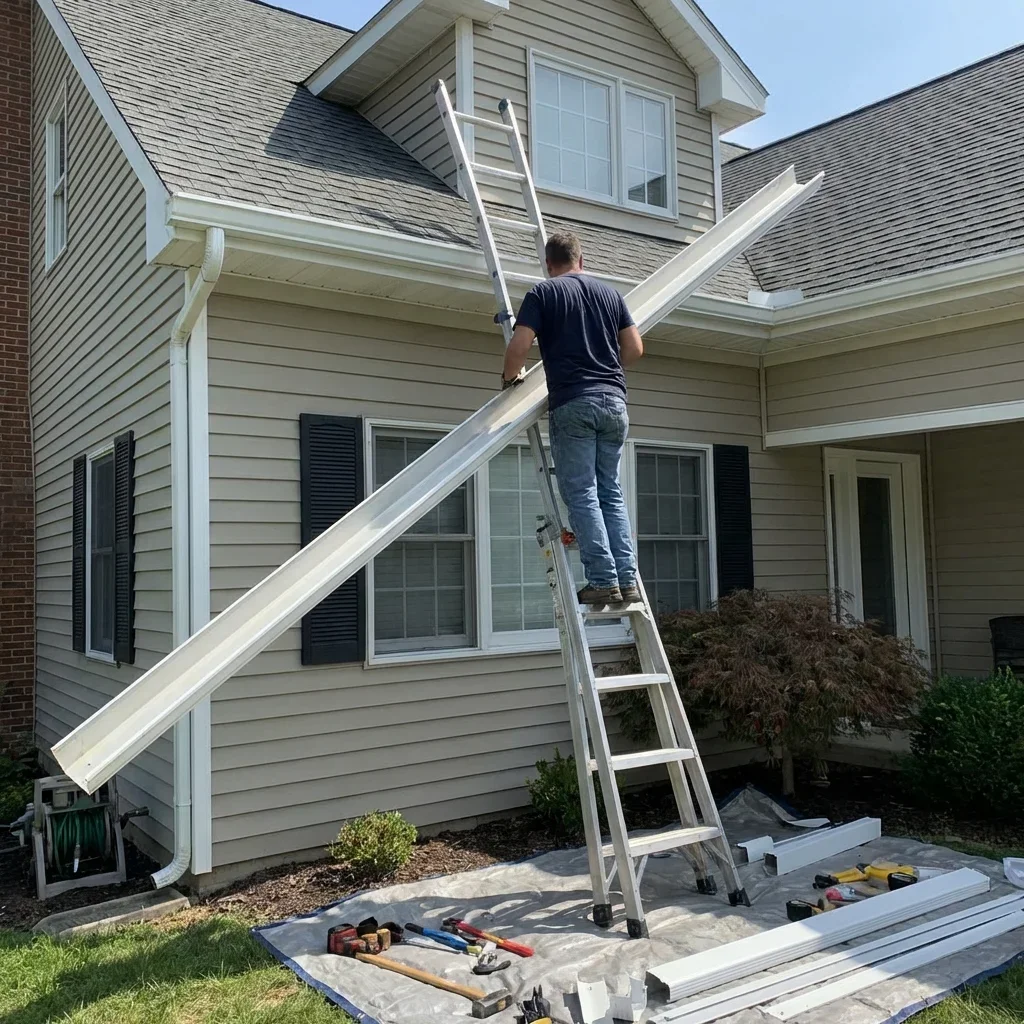
DIY gutter installation makes sense for small, simple projects — replacing a 10-foot damaged section on a single-story garage, installing gutters on a garden shed, or repairing a short run where you can clearly see the problem and match the existing system.
These are projects where the stakes are low, the work is at manageable height, and you're not trying to engineer water flow for your entire house.
For everything else, professional installation is worth the cost. Multi-story homes, complex rooflines with valleys and dormers, houses with questionable fascia, or situations where you're replacing an entire gutter system — these need contractor expertise. The pros who do this daily have seen every weird roof configuration, every type of fascia failure, every drainage problem. They can look at your house and immediately know whether you need 5-inch or 6-inch gutters, where downspouts should go for proper drainage, and how to handle that weird valley where water concentrates.
The cost comparison becomes clearer when you factor in everything: materials from Home Depot, hangers and fasteners, sealants and rivets, rental fees for quality ladders or scaffolding, the value of your weekend time, and the risk that you'll need to redo work that doesn't perform correctly. Professional installation typically includes warranties on both materials and labor, which matters when you're talking about a system that needs to function perfectly during every rainstorm for the next 20 years.
Contractors also handle the details that don't occur to DIYers until it's too late. They flash behind the gutters properly, ensuring water that runs down your fascia doesn't get trapped between the gutter and the board. They check soffit and fascia condition before mounting anything, identifying rot that needs repair first. They match downspout elbows and extensions to your home's architecture and local drainage requirements.
This is system design, not just parts assembly.
Pro Tip: If you've already bought those 20-foot sections from Home Depot and you're reconsidering the DIY approach, most contractors will happily provide a free estimate. Some might even be willing to use materials you've purchased if they're appropriate for your house, though most prefer to supply their own to ensure quality and maintain warranty coverage.
If you've already bought those 20-foot sections from Home Depot and you're reconsidering the DIY approach, most contractors will happily provide an estimate. Some might even be willing to use materials you've purchased if they're appropriate for your house, though most prefer to supply their own to ensure quality and maintain warranty coverage.
The conversation costs nothing, and it might save you from a weekend of frustration followed by a repair bill when the system underperforms.
Find Gutter Installation Contractors Near You
The contractors who do gutter work well are usually specialized companies that focus primarily or exclusively on gutter installation. They're not general handymen trying to pick up extra work — they're businesses that own roll-forming equipment, understand drainage engineering, and have refined their installation process through hundreds of homes.
When you're vetting contractors, ask about their experience with seamless systems specifically. Anyone can buy sectional gutters and hang them, but seamless fabrication requires equipment and expertise. Ask how they calculate gutter size and slope, how they handle complex rooflines, and what their warranty covers.
Good contractors will walk your roofline, check your fascia, ask about past water problems, and explain what they'd do differently than a basic sectional installation.
You don't need to become a gutter expert before calling contractors. You just need to understand that gutter installation is more complex than buying the right sections, and that the research you've done on materials and sizes puts you in a better position to have informed conversations about what your house needs.