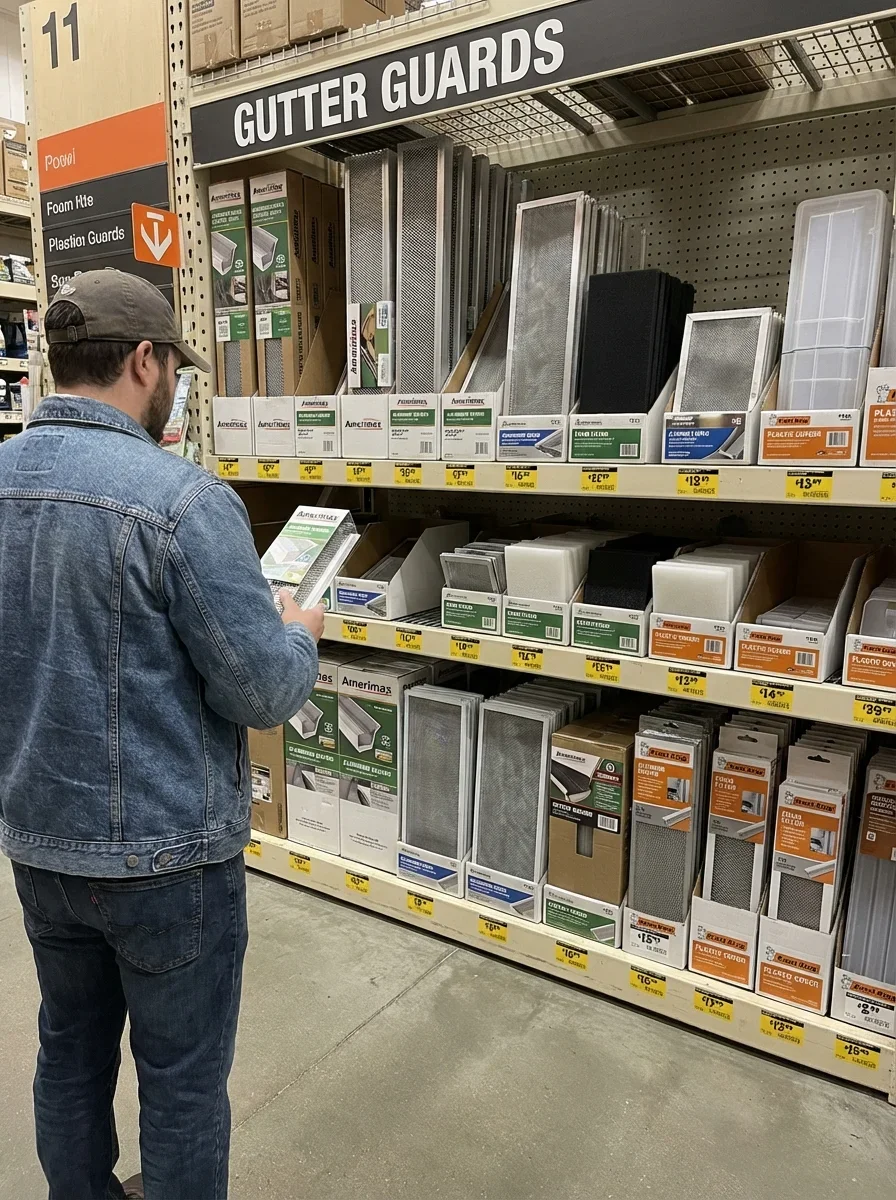
What Gutter Guards Does Home Depot Sell?
Walk into any Home Depot and you'll find roughly a dozen gutter guard options, most priced between $1 and $4 per linear foot. The selection typically includes brands like Amerimax, Frost King, and their own HDX house brand. You'll see plastic mesh screens, foam inserts, aluminum perforated covers, and brush-style guards that look like oversized pipe cleaners.
The products are grouped by installation method rather than by performance capability. That matters because the easiest products to install are usually the least effective at keeping debris out.
The store layout guides you toward simple snap-in options, which move inventory but don't necessarily solve your gutter problems long-term.
Snap-In Systems and Mesh Screens
The most popular Home Depot options are snap-in plastic screens that clip onto the front gutter lip without screws or fasteners. They install quickly — you can do a full house in an afternoon — but they also detach just as easily during storms or when debris builds up and creates weight. These screens work by surface tension, allowing water to flow over a mesh while (theoretically) keeping leaves out.
Most snap-in products use UV-treated plastic that degrades within 3-5 years of sun exposure.
You'll notice the material becoming brittle first, then cracking along the mounting clips. Wind is the other enemy here. Without mechanical fasteners, these guards rely entirely on friction. A strong gust combined with a wet leaf mat creates enough lift to pop entire sections out of place.
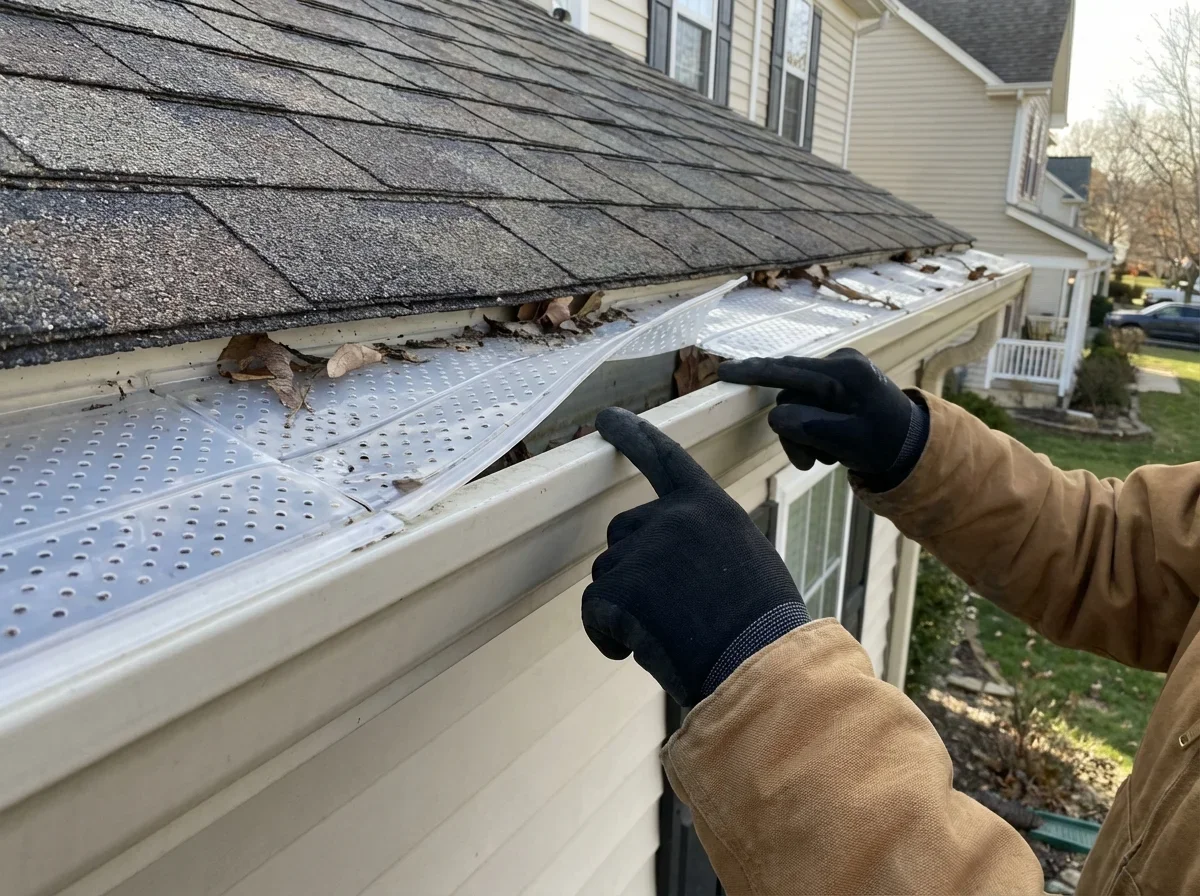
The aluminum mesh versions sold at Home Depot are slightly more durable but face the same installation challenges. They bend easily during installation, and once the mesh is dented, water tends to pool in the low spots rather than flowing through to your gutters.
DIY Installation Products
Home Depot also stocks screw-down options that require drilling into your fascia board or roof decking. These provide better security than snap-in systems, but installation suddenly becomes more complex. You're now creating penetration points that need proper sealing to prevent rot, and you're responsible for maintaining the correct pitch so water flows toward downspouts rather than pooling on top of the guard.
Foam insert guards are the simplest installation — you just push them into your gutters.
They're also the most problematic. The porous foam absorbs water, which means it never fully dries between rain events. Seeds germinate inside the foam, creating small plants growing directly in your gutters. The material breaks down within 2-3 years, turning into a sludgy mess that's harder to clean out than regular debris.
Brush guards consist of bristles that sit inside the gutter channel. Debris is supposed to rest on top while water flows through, but in practice, small particles get trapped between bristles and eventually create a mat that blocks water entirely. Cleaning them requires pulling out each section and manually removing compacted debris from between hundreds of bristles.
| Guard Type | Installation Time | Typical Lifespan | Best For | Major Drawback |
|---|---|---|---|---|
| Snap-In Plastic Mesh | 2-4 hours | 3-5 years | Simple rooflines, minimal trees | Detaches easily in storms |
| Foam Inserts | 1-2 hours | 2-3 years | Emergency short-term use | Absorbs water, grows plants |
| Brush Guards | 2-3 hours | 3-4 years | Light debris areas | Traps particles between bristles |
| Screw-Down Aluminum | 4-6 hours | 5-8 years | Moderate protection needs | Requires fascia penetration |
Home Depot Installation Service vs. Local Contractors
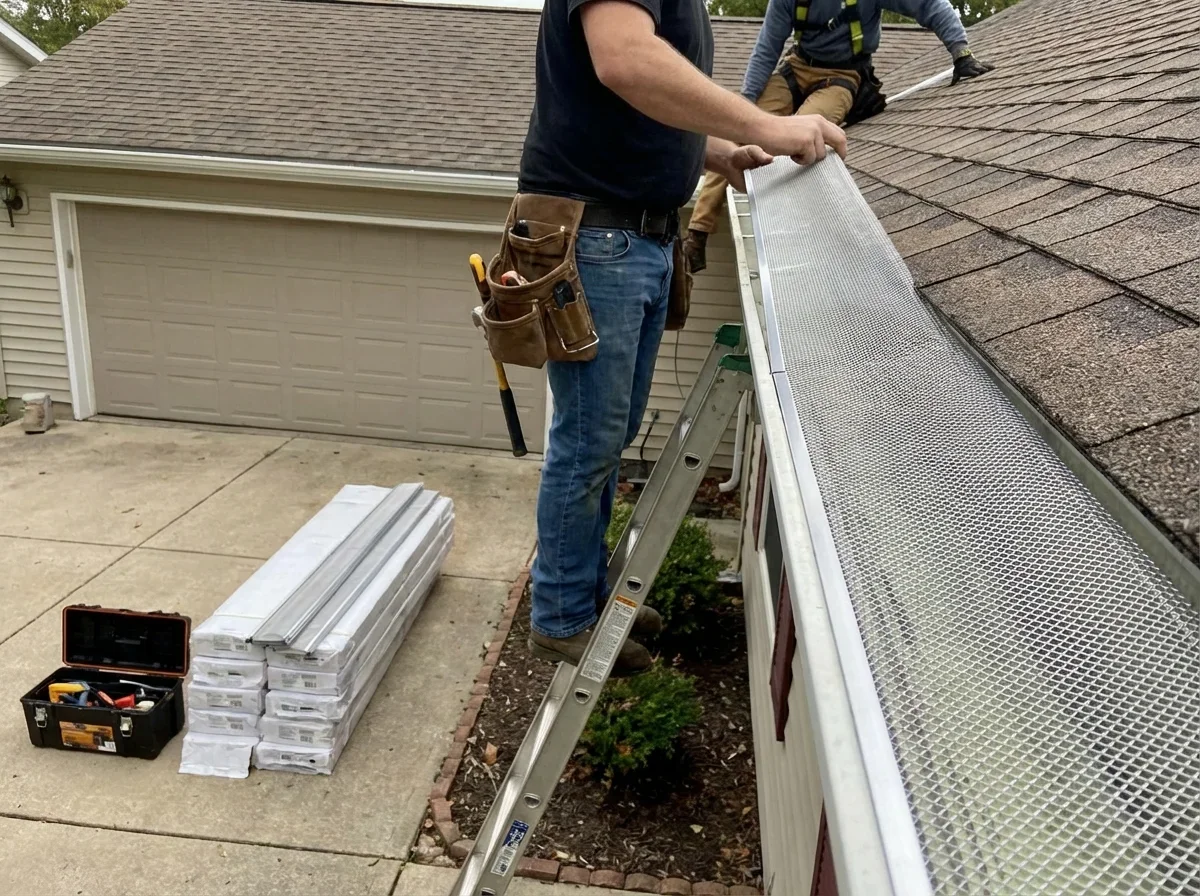
Home Depot offers gutter guard installation through their installed services program, which sounds convenient until you understand how it works. The store doesn't employ installers directly. They contract with local companies who bid on jobs in their network, and those contractors are often looking for volume work rather than quality installations.
The products installed through Home Depot's service are typically the same retail-grade materials you see on the shelves, sometimes with slight modifications for contractor use.
You're paying for labor, but you're not getting access to the commercial-grade materials that independent contractors use for their warranty-backed work. The installation crews are competent, but they're working within Home Depot's pricing structure and product limitations.
Warranties through Home Depot's installation service are split between product defects (covered by the manufacturer) and installation issues (covered by Home Depot for one year). That distinction matters when your guards start failing. If the screen material itself cracks, the manufacturer might cover replacement. If the guards blow off because they weren't properly secured, you're dealing with Home Depot's service department to coordinate a return visit from whichever contractor is available in your area.
Independent local contractors typically won't install Home Depot products even if you already bought them.
The profit margins are too thin, the warranty liability doesn't make sense, and they know the performance won't reflect the quality of their work. If a contractor builds their reputation on 20-year gutter guard installations, they can't risk that reputation on 5-year retail products.
Common Problems with Retail Gutter Guards
The failure patterns of big-box gutter guards are predictable because they stem from the same fundamental compromises: lightweight materials, simple installation methods, and designs optimized for manufacturing cost rather than real-world performance.
Gaps are the most immediate issue.
Retail guards come in standard lengths that rarely match your actual gutter runs perfectly. You'll end up with seams between sections where leaves collect, or you'll need to cut pieces to fit corners and end caps. Each cut and each seam is a potential entry point for debris. Professional systems are custom-fabricated to your exact measurements, eliminating most seams entirely.
Material Durability and Longevity
Plastic products degrade under UV exposure, which is non-negotiable physics. The polymer chains break down, the material becomes brittle, and eventually it cracks under normal stress. UV inhibitors in the plastic slow this process but don't stop it. A snap-in guard that feels sturdy in the store will be noticeably more brittle after two summers of direct sun.
Aluminum retail guards fare better against UV but introduce different problems.
The aluminum used in Home Depot products is typically thinner gauge (around .019" thick) compared to professional-grade materials (.024" to .032" thick). That difference seems minor until you're trying to maintain the guard's shape during installation or when winter ice forms on top. Thin aluminum dents easily and doesn't spring back to its original form.
Temperature cycling also impacts retail products more severely. Materials expand and contract with heat and cold, which works fine when they're installed with proper expansion gaps and flexible mounting. But snap-in systems don't accommodate thermal movement — they're either clipped in or they're not. Over multiple seasons, this expansion and contraction loosens the mounting connection even if the material itself hasn't failed yet.
Installation Quality Issues
Most DIY gutter guard failures aren't product failures — they're installation mistakes.
Maintaining proper slope is critical for any gutter guard system. Water needs to flow toward downspouts rather than sitting on top of the guard or pooling at seams. When you're installing from a ladder, checking pitch along a 30-foot run is difficult. Professional installers use levels and measuring tools to verify slope before securing anything permanently.
Fascia attachment is the other common weak point. Screw-down systems require fasteners placed into solid wood, not just shingles or drip edge. If you miss the fascia board and penetrate only the thin material behind it, the screw will pull out under weight or wind pressure. Finding the fascia from a ladder while managing a long section of gutter guard requires either experience or multiple attempts with patched holes as the learning curve.
Shingle compatibility causes problems that don't appear until rain events.
Many gutter guards are designed to slide under the first row of shingles, which works great in marketing photos but requires lifting shingles without breaking the seal or tearing them. If your roof is more than a few years old, those shingles are brittle. Breaking them during installation means roof leaks that cost far more than gutter cleaning ever did.
Warning: The most expensive gutter guard isn't the one you buy — it's the one that fails and causes water damage to your fascia, soffit, or foundation. A $400 DIY installation that lasts three years before allowing overflow can easily create $3,000+ in repair costs.
When DIY Makes Sense (And When It Doesn't)
There are legitimate scenarios where Home Depot gutter guards are the right choice. If you're dealing with a rental property where you need basic protection for 3-5 years before potentially selling, retail products can provide adequate value. They'll reduce the worst debris accumulation without requiring the investment that professional systems demand.
Straight runs with minimal trees are also reasonable candidates for DIY products.
If you've got a 20-foot section of gutter with a clear roof and no overhanging branches, a well-installed retail guard will perform acceptably. The failure modes that plague complex installations — corner gaps, valley overflow, wind uplift on long spans — don't apply to simple configurations.
Short-term solutions make sense when you're planning other work. If you know you'll be replacing your roof in two years, installing a premium gutter guard system now means paying for installation twice. A simple foam or snap-in product gets you through the interim without significant investment in a system you'll need to remove anyway.
But if you're looking at a permanent solution for a house with mature trees, complex rooflines, or previous water damage issues, retail products aren't cheaper — they're just cheaper today.
When you factor in the replacement cycle, the time spent on second installations, and the risk of damage from overflow during the years when failed guards are letting debris through, the total cost over ten years often exceeds what professional installation would have cost upfront.
What Professional Installation Actually Costs
Professional gutter guard installation typically runs $8-$30 per linear foot depending on your product choice and roof complexity. For a standard 150-foot home, you're looking at $1,200-$4,500 installed. That feels steep compared to the $200-$400 you'd spend on Home Depot products plus an afternoon on a ladder.
But professional pricing includes several things retail products don't.
Custom fabrication to your exact measurements, commercial-grade materials with 15-25 year warranties, proper integration with your roofline, and labor from insured contractors who know how to identify and fix gutter problems before they install protection. You're also getting a product that contractors are willing to warranty, which says something about their confidence in its performance.
The material difference alone justifies some of the price gap. Professional-grade micro-mesh systems use stainless steel mesh over an aluminum frame, with both materials selected for longevity rather than manufacturing cost. The mesh openings are small enough to block roof grit and pine needles, not just large leaves. The frame is rigid enough to maintain shape under ice and debris weight.
Installation quality matters more than most homeowners realize until they've dealt with poor installation.
Professional crews verify and correct gutter pitch before installing guards, seal all penetrations properly, ensure downspouts are clear and properly sized, and test water flow during installation. Those steps prevent the most common failure modes that plague DIY installations.
10-Year Cost Comparison: DIY vs. Professional
- Home Depot DIY: $400 initial + $400 replacement (year 4) + $400 replacement (year 8) = $1,200 total
- Professional Installation: $2,400 one-time investment (20+ year lifespan)
- Hidden DIY costs: 12+ hours installation time over 3 installations, ladder rental/purchase, potential water damage repair
- Break-even point: Professional systems typically pay for themselves by year 7-8 when factoring in replacement cycles and labor
Find Contractors Who Offer Better Alternatives
If the Home Depot options don't meet your needs and you're ready to explore professional installation, look for contractors who specialize in gutter protection rather than general handyman services. Specialists have experience with multiple product lines and can recommend systems based on your specific tree coverage, roof type, and budget.
Ask potential contractors which products they install and why they prefer those systems.
Be skeptical of anyone who only offers one brand — they're likely locked into a franchise or dealer agreement rather than selecting products based on performance. Good contractors can explain the trade-offs between micro-mesh, reverse-curve, and perforated systems, and they'll ask about your property before recommending a solution.
Verify that any contractor you consider carries general liability insurance and workers compensation coverage. Gutter work means ladders and roof edges, which creates injury risk. If an uninsured worker falls on your property, your homeowner's insurance becomes the primary coverage. Request certificates of insurance before any work begins.
Check how the warranty is structured.
The best warranties cover both the product and the installation, with the contractor standing behind the work. Avoid warranties that require you to chase down manufacturers directly for product defects while handling installation issues separately. That split responsibility creates gaps where failures can fall through without resolution.