
What Gutter Guard Products Does Lowe's Sell?
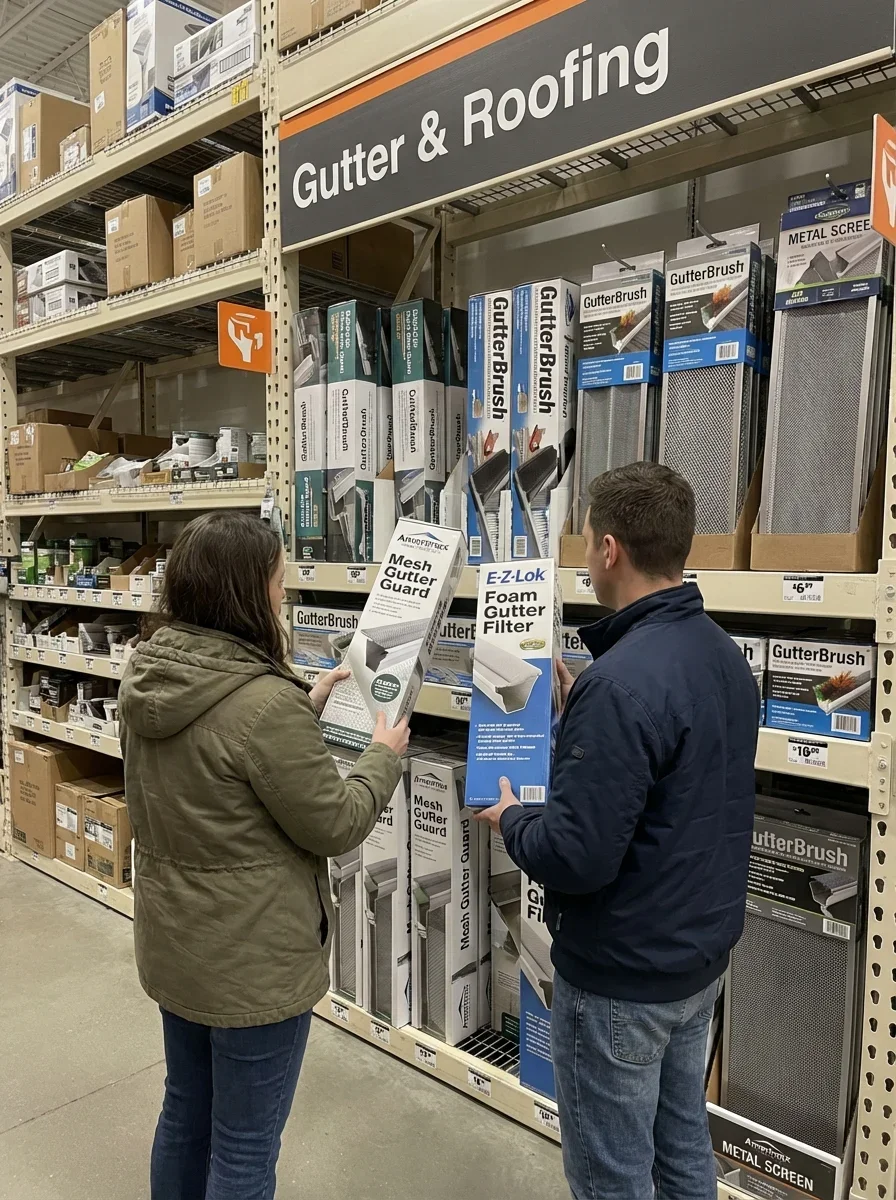
Walk into any Lowe's and you'll find three main categories of gutter protection: mesh screens, foam inserts, and brush-style systems. The selection centers on brands like Amerimax, GutterBrush, and E-Z-Lok, with pricing that ranges from $1.50 to $8 per linear foot depending on material quality.
Most products use snap-together or clip-on installation methods that don't require lifting shingles or modifying your existing gutters. The mesh screens — typically aluminum or plastic frames with stainless steel or polyethylene mesh — dominate the shelf space because they balance ease of installation with debris-blocking capability.
Foam inserts sit inside the gutter channel and cost less upfront, but they clog quickly with fine debris like pine needles and roof grit[1].
Available Brands and System Types
Amerimax offers the broadest selection at Lowe's, including their Titan series with a 20-year warranty and Lock-In models that clip onto standard gutter lips. These aluminum-frame guards with expanded metal mesh handle leaves and larger debris but allow smaller particles to pass through or accumulate on top.
GutterBrush uses a different approach entirely — bristle-filled cylinders that sit inside your gutters and trap debris while letting water flow around the bristles. Installation takes minutes.
But the bristles collect organic material that eventually composts inside your gutters, requiring removal and cleaning every year or two[2]. E-Z-Lok systems feature interlocking sections with fine mesh, designed for homeowners who want better filtration than standard screens provide.
| Brand | System Type | Price Range (per linear foot) | Installation Method | Best For |
|---|---|---|---|---|
| Amerimax | Mesh screens (aluminum frame) | $2.50-$6.00 | Clip-on to gutter lip | General leaf protection |
| GutterBrush | Bristle-filled cylinders | $1.50-$3.00 | Drop-in placement | Quick DIY installation |
| E-Z-Lok | Fine mesh interlocking | $4.00-$8.00 | Snap-together sections | Better filtration needs |
5-Inch and 6-Inch Sizing Options
Most residential gutters use 5-inch K-style profiles, and Lowe's stocks guards specifically sized for this standard dimension. The 5-inch options from brands like Amerimax and E-Z-Lok fit the front-to-back width of typical gutters, but you'll need to measure carefully. Some products require trimming with tin snips, and corner pieces often need separate purchases.
Finding 6-inch gutter guards at Lowe's gets considerably harder. These wider guards accommodate commercial-grade or older oversized residential gutter systems, but retail inventory focuses almost entirely on the 5-inch standard.
If your home has 6-inch gutters, you'll likely need to special-order through Lowe's or go directly to a professional supplier. The installation also becomes more complex with larger gutters, since the added width increases stress on clip-based mounting systems during high winds.
Lowe's Installation Service vs. Local Contractors
Lowe's offers professional installation through their third-party contractor network, marketed as a turnkey solution for homeowners who don't want to DIY. You schedule through the store, get a quote based on linear footage, and a contractor arrives to handle the work.
The reality involves more moving parts than the sales pitch suggests.
The contractors who show up work for independent companies hired by Lowe's, not Lowe's employees. Quality varies dramatically depending on which local company gets assigned to your job. Some homeowners report excellent experiences with knowledgeable installers who properly secured guards and cleaned up thoroughly. Others dealt with rushed installations where guards weren't fastened to manufacturer specs, creating gaps that let debris through or sections that blew off during the first windstorm.
Warranty coverage splits between the product manufacturer and the installation labor. If your guards fail due to material defects, you're dealing with Amerimax or whoever made the product. If they fail because of improper installation, you're back to Lowe's trying to prove the contractor made mistakes.
Independent local contractors typically offer unified warranties covering both materials and labor, with one company responsible for the entire system's performance[3].
Key Insight: Lowe's installation uses third-party contractors with split warranty coverage (product vs. labor), while independent contractors typically provide unified warranties covering the entire system under one roof. This difference matters significantly when problems arise years after installation.
Common Limitations of Retail Gutter Guards
The gutter guards you find at big-box stores solve one specific problem — blocking leaves and large debris from entering your gutters. They don't solve the dozen other issues that come with protecting gutters in real-world conditions.
The gap between expectation and performance frustrates homeowners who thought "install and forget" was realistic.
Material Quality and Durability
Retail guards use lighter-gauge materials to hit price points that work for DIY budgets. The aluminum frames on mid-tier products measure around 0.019 inches thick compared to professional-grade systems that use 0.032-inch or heavier aluminum.
That difference matters when summer heat expands the metal or winter ice adds weight — thinner frames warp, bend, and develop gaps at the seams.
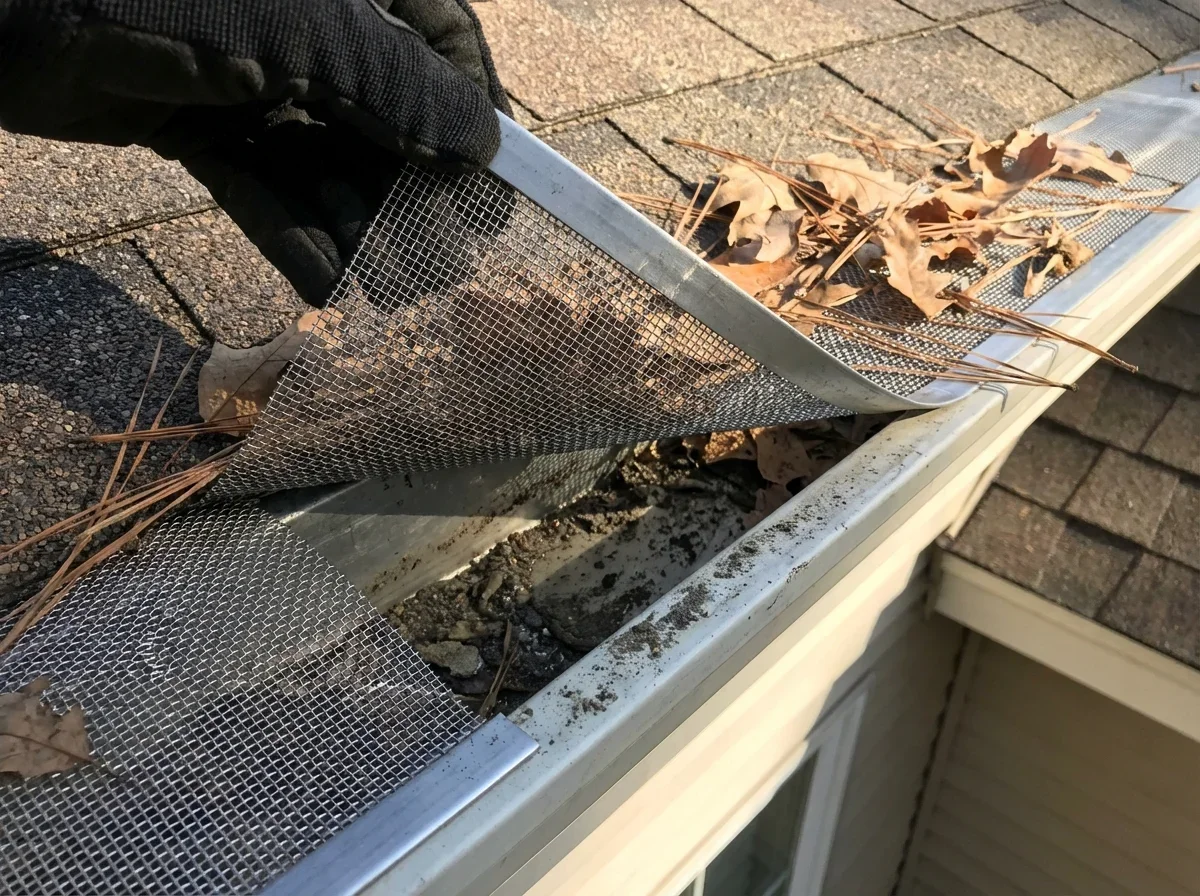
Plastic-based guards become brittle after a few years of UV exposure. Homeowners report sections cracking during routine cleaning or collapsing entirely under snow load. The mesh itself varies widely in quality; stainless steel micro-mesh resists corrosion and maintains spacing, while cheaper polyethylene mesh stretches over time and develops sags where debris accumulates[2].
Some guards arrive damaged from shipping, with bent sections or cracked mounting clips that require straightening before installation.
Installation Integrity Issues
Snap-together systems rely on friction and small clips to stay in place, which creates vulnerability points that don't exist with guards secured under shingles or screwed into fascia boards. During heavy rain with strong winds, water can shoot over unsecured guards while debris piles up at seams where sections connect.
The interlocking mechanisms work fine in calm conditions but separate when stressed.
No retail guard system addresses the pitch and alignment issues that exist in real gutters. Your gutters probably aren't perfectly straight — they sag slightly in the middle, have minor dips near downspouts, or sit at inconsistent angles depending on how they were originally hung. Rigid guards designed for perfect conditions don't adapt to these imperfections.
You end up with gaps where water shoots past the guard or sections that sit too high and let debris slide underneath[3].
Pine needles and fine debris create the most persistent problem. Even micro-mesh guards with tiny perforations allow needles to mat on top of the surface, eventually forming a barrier that sheds water over the gutter edge instead of letting it through. You're not climbing ladders to scoop soggy leaves anymore, but you're still cleaning — just brushing off the top of the guards instead of the inside of the gutters[1].
When Lowe's Products Are Sufficient
Retail gutter guards work well in specific scenarios where their limitations don't matter. If you're dealing with a small ranch house surrounded by lawns rather than mature trees, a $200 investment in Amerimax screens might solve your problem completely.
The key is matching the product's capabilities to your actual conditions rather than hoping it performs beyond its design.
Low-debris environments are ideal for DIY guards. Homes in subdivisions with young landscaping or desert climates with minimal vegetation don't generate the leaf volume that overwhelms retail systems. You might clean the guards once or twice a year, but that maintenance schedule beats monthly gutter cleaning.
Budget constraints also make retail options sensible as interim solutions — protecting your gutters with $300 in materials while you save for a complete professional system keeps water damage at bay.
Temporary coverage situations benefit from the easy installation and removal of snap-on guards. If you're planning to replace your gutters in the next few years but need protection now, spending thousands on a permanent guard system doesn't make sense. The same logic applies to rental properties where you want basic maintenance reduction without major capital investment.
Lowe's Gutter Guards Work Best For:
- Small homes (under 1,500 sq ft) with minimal tree coverage
- Low-debris environments like desert climates or new subdivisions
- Temporary protection while saving for professional systems
- Rental properties requiring basic maintenance reduction
- Budgets under $500 for complete gutter protection
- DIY-capable homeowners comfortable with annual maintenance
What Professional Installation Provides
Professional gutter guard systems cost more because they solve problems retail products don't address. The guards themselves use heavier materials with better engineering, but the installation quality creates the meaningful difference.
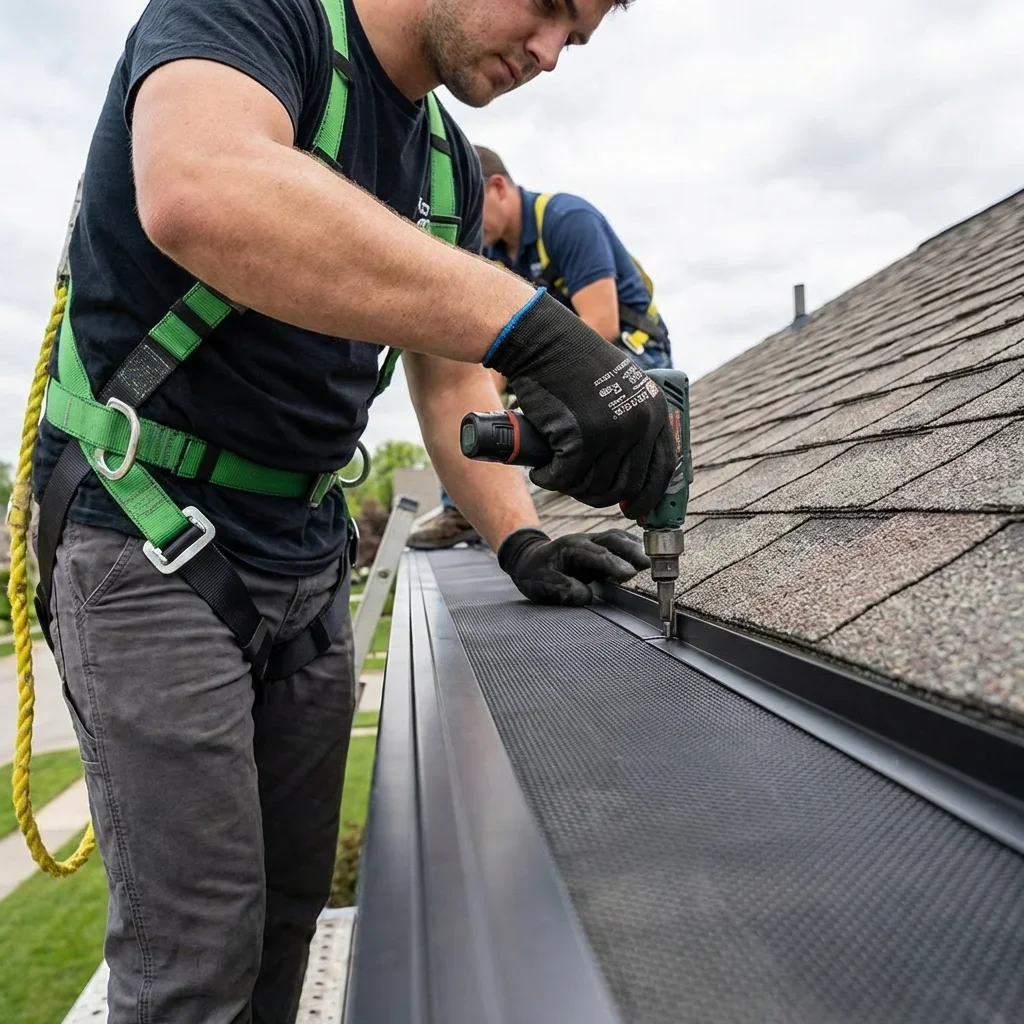
Professional installers measure and custom-cut guards to match your specific gutter profile, account for pitch variations, and secure the system in ways that withstand weather extremes.
Hidden hanger systems attach guards under your roof shingles and to the gutter's front edge, creating a mechanical bond that doesn't rely on clips or friction. This mounting method prevents guards from lifting during high winds and maintains consistent spacing between the guard surface and the gutter bottom.
The system becomes part of your roof's water management rather than an accessory sitting on top of your gutters.
Professional-grade materials include surgical-grade stainless steel micro-mesh that filters out debris as small as roof grit while maintaining water flow rates that exceed your gutters' capacity[2]. The aluminum frames use continuous lengths with minimal seams, eliminating the connection points where retail systems accumulate debris.
Many professional products also feature a forward slope design that uses surface tension to carry debris off the front edge while water adheres to the guard and flows into the gutter.
Unified warranties cover both materials and labor for 20 to 30 years or even lifetime guarantees. If anything fails — material defect, installation error, or performance issue — one company handles the entire repair or replacement. You're not navigating between a product manufacturer and an installation contractor trying to assign blame.
Find Qualified Gutter Guard Installers
Choosing between Lowe's guards and professional installation comes down to matching your home's specific conditions with the appropriate level of protection. If you have mature trees, heavy rainfall, or complex rooflines with valleys and multiple downspouts, retail products will underperform regardless of how carefully you install them.
The ongoing maintenance and eventual replacement costs often exceed the upfront investment in professional systems.
Professional installers provide detailed assessments of your gutters, roof pitch, and surrounding vegetation before recommending specific guard types. They identify problem areas where water volume concentrates or debris accumulates, then engineer solutions that address those trouble spots. The best contractors offer maintenance plans that include periodic inspections and cleaning, ensuring your guards continue performing years after installation.
Frequently Asked Questions
- University of Minnesota Extension. "Gutter Guards." https://extension.umn.edu/moisture-and-mold-indoors/gutter-guards. Accessed February 08, 2026.
- Clemson University Cooperative Extension. "Are Gutter Guards Worth It?." https://hgic.clemson.edu/factsheet/are-gutter-guards-worth-it/. Accessed February 08, 2026.
- Penn State Extension. "Gutter Guards." https://extension.psu.edu/gutter-guards. Accessed February 08, 2026.