
What Are Gutter Splash Guards and When Do You Need Them?
Gutter splash guards are metal or vinyl deflectors installed at points where water consistently overshoots your gutters. They redirect concentrated water flow back into the gutter channel instead of letting it cascade over the edge.
Most contractors recommend them for specific trouble spots rather than entire gutter runs. You'll see them called splash guards, deflectors, or diverters depending on their design. The aluminum versions handle high-volume flow better than vinyl options, which tend to become brittle after a few freeze-thaw cycles.[3]
Professional installations focus on problem areas where volume overwhelms the gutter's capacity to catch water, not where the gutter itself is failing.
Common Problem Areas Where Splash Guards Help
Roof valleys concentrate water from two planes into a single stream that hits your gutter at high velocity. Without deflection, that concentrated flow shoots straight across the gutter channel and over the front edge.
Dormers create similar problems where a secondary roofline dumps water onto the main roof's gutter run. Outside corners where two gutter sections meet also generate overflow during heavy rain. The water arrives from both directions simultaneously, creating turbulence that sends spray over the gutter lip.
Steep roof pitches compound all these issues by accelerating water speed before it reaches the gutter.
Key Problem Locations at a Glance:
- Roof valleys — Water from two roof planes converges into high-velocity streams
- Dormers — Secondary rooflines dump water mid-run onto main gutters
- Outside corners — Dual-direction water flow creates overflow turbulence
- Steep pitches — Accelerated water velocity makes redirection difficult
- Long gutter runs — Accumulated volume overwhelms capacity at end points
Why Water Overshoots Gutters in Certain Spots
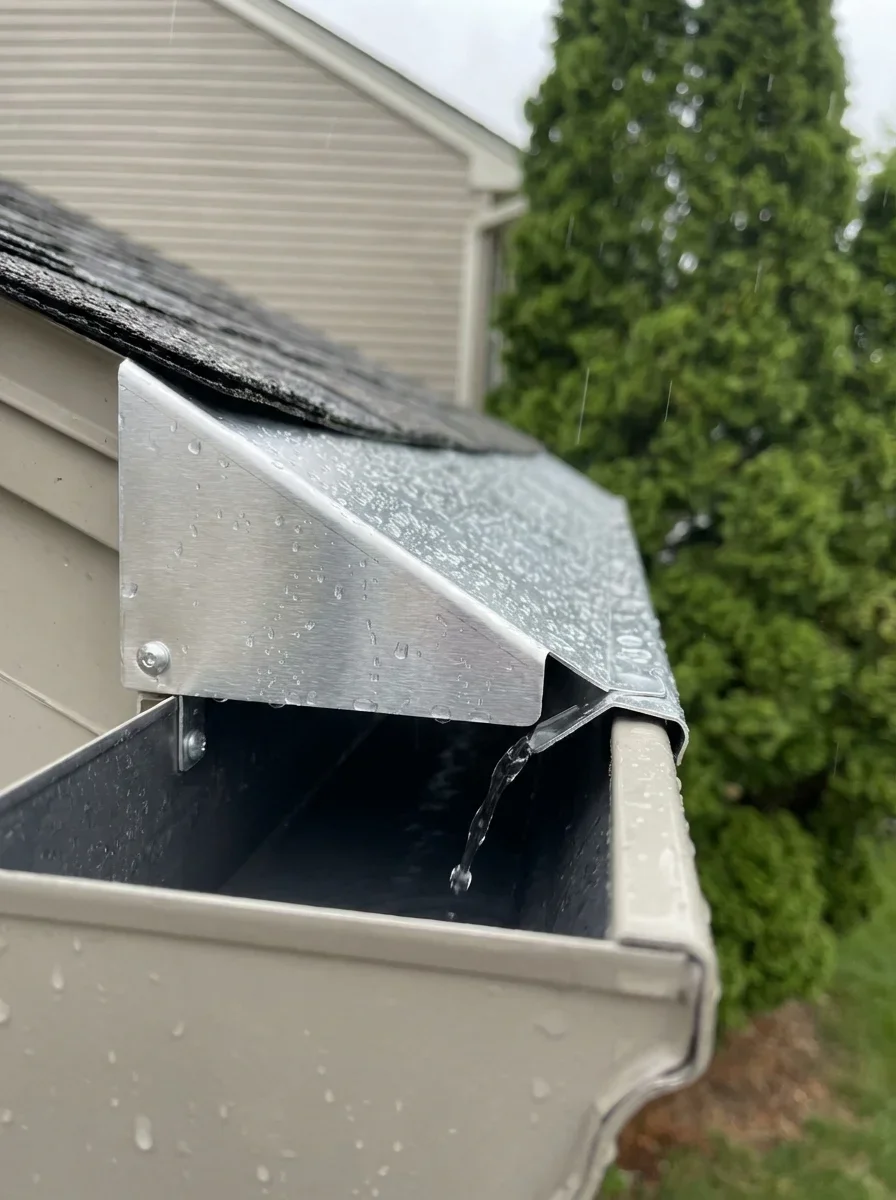
Water overshoots when its velocity or volume exceeds what the gutter geometry can handle. A 5-inch gutter catches water falling vertically just fine, but struggles when water arrives at an angle or with significant horizontal momentum.
Roof pitch determines how fast water travels — steeper slopes mean faster water that's harder to redirect into the gutter channel. Valley concentration multiplies the problem by funneling water from large roof sections into narrow streams. A valley collecting runoff from 800 square feet of roof sends far more water than the same gutter handles from a simple slope.
If your downspout capacity can't keep up with valley flow, water backs up and overflows even with splash guards in place.
Undersized downspouts create the same overflow symptoms as missing splash guards. If you have one downspout serving 40 feet of gutter that collects valley runoff, no deflector will fix the fundamental drainage bottleneck. The water has to go somewhere, and it'll find the path of least resistance.
Types of Splash Guards Contractors Use
Aluminum Deflectors and Diverters
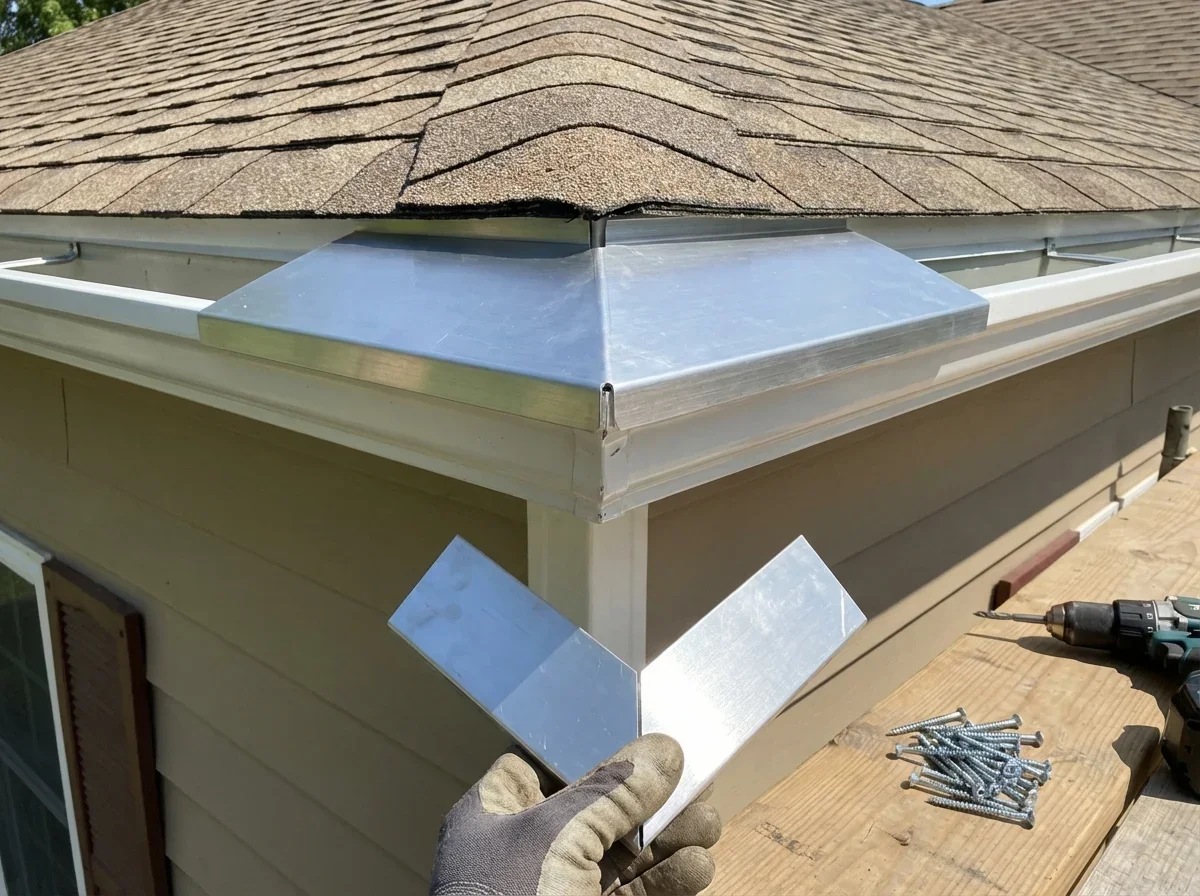
Aluminum deflectors mount to the gutter's front edge and angle back toward the house, creating a surface that redirects water flow. They're typically 6 to 8 inches tall and extend several inches along the gutter run.
The 7-inch width options create a noticeable profile on standard 5-inch gutters, which some homeowners find visually obtrusive.[3] Professional-grade aluminum guards hold up in harsh weather conditions where vinyl alternatives fail. They don't crack in cold temperatures or warp in summer heat.
Contractors prefer them for permanent installations because they match gutter material and finish, creating a cohesive look rather than an obvious add-on.
Valley Guards and Dormer Solutions
Valley guards are wider deflectors specifically designed for high-volume concentration points. They often span 12 to 18 inches of gutter length and angle more aggressively than standard splash guards. Some designs incorporate a curved profile that gradually redirects water rather than creating a hard angle.
Dormer solutions sometimes require extended gutter sections rather than simple deflectors.
When a dormer dumps water mid-run, contractors may install a raised gutter segment that sits higher to catch the elevated water stream. This approach works better than deflectors when the dormer edge sits several inches above the main gutter line.
| Feature | Aluminum Deflectors | Vinyl Deflectors | Valley Guards | Dormer Extensions |
|---|---|---|---|---|
| Best For | General overflow spots | Light-duty applications | Roof valleys & high flow | Mid-run dormer discharge |
| Durability | 15-20+ years | 5-8 years | 15-20+ years | 20+ years |
| Temperature Tolerance | Excellent | Poor (cracks/warps) | Excellent | Excellent |
| Coverage Length | 6-8 inches | 6-8 inches | 12-18 inches | Custom fabricated |
| Typical Cost | $50-$150 installed | $40-$100 installed | $150-$300 installed | $200-$400 installed |
How Professionals Install Splash Guards Correctly
Contractors start by assessing why water overshoots in that specific location. They measure roof pitch, calculate drainage area, and check downspout capacity before installing any deflector.
If the underlying issue is inadequate drainage capacity, they address that first — splash guards won't fix a fundamentally undersized system.
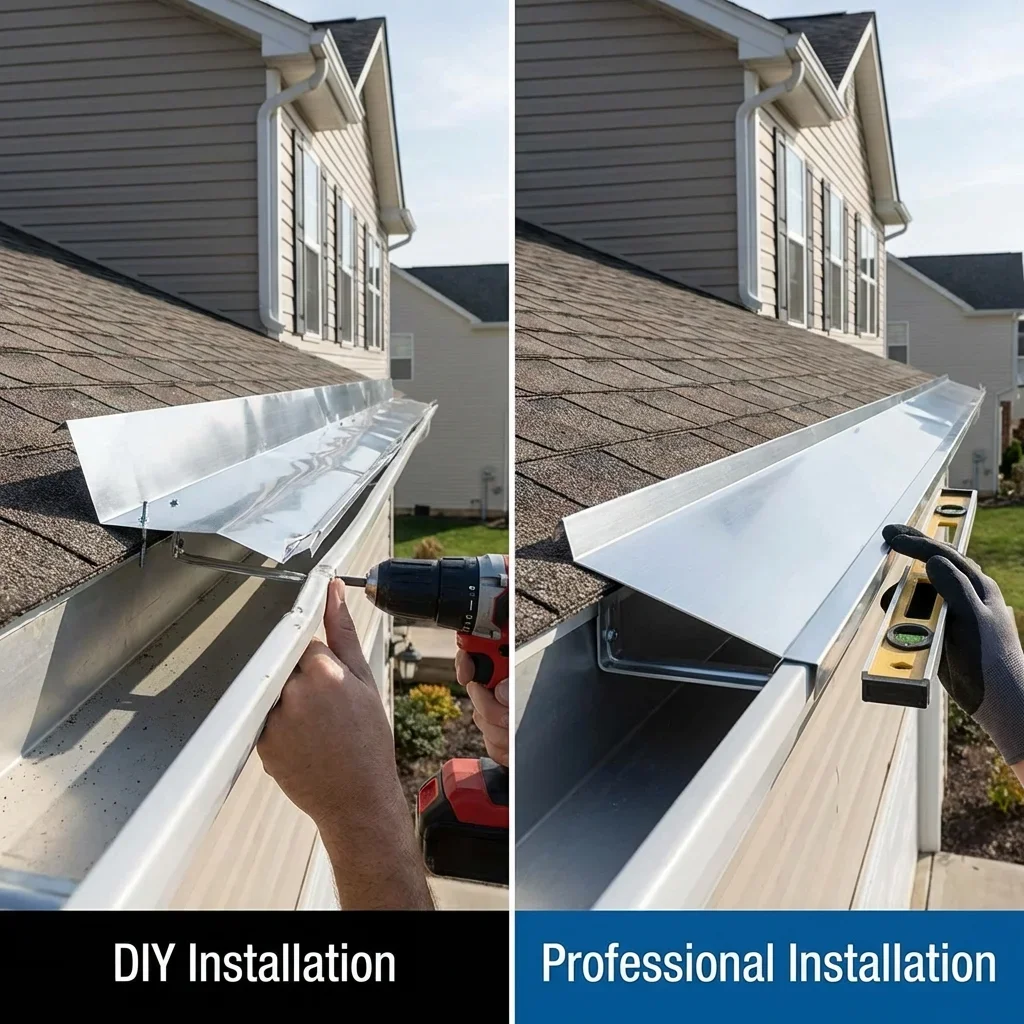
Proper installation requires pulling back shingle tabs to secure fasteners directly to the fascia board or gutter back. Homeowners who've attempted DIY installations report struggling with this step, especially while balancing on a ladder.[1] The backside attachment proves particularly difficult with overhanging shingles that need to be lifted without damage.
Professional installations reinforce gutter brackets near splash guard locations. The deflector itself adds wind resistance, and the redirected water creates additional weight in that gutter section. Contractors add brackets or adjust existing ones to prevent sagging.
They also check gutter pitch after installation — deflectors shouldn't create low spots where water pools instead of flowing toward downspouts.
The angle matters more than homeowners expect. Too steep and water bounces off the deflector and still escapes; too shallow and it doesn't redirect effectively. Experienced contractors adjust the mounting angle based on roof pitch and observed water velocity during rain events.
What Do Splash Guards Cost?
Splash guards installed as part of broader gutter work typically cost $50 to $150 per location. That price includes the guard itself, proper fastening, and integration with your existing gutter system.
Standalone installations where a contractor returns specifically to add splash guards run $100 to $200 per location due to trip charges and setup time. Material choice affects cost less than installation complexity. Aluminum guards cost $15 to $30 as components, while vinyl versions run $8 to $15.
The labor portion dominates pricing because proper installation requires accessing the gutter, potentially adjusting shingles, reinforcing brackets, and ensuring proper pitch.
Valley guards and custom dormer solutions cost more — expect $150 to $300 for these specialized installations. They often involve fabricating extended gutter sections or creating custom deflectors that match your specific roof geometry. Standard off-the-shelf deflectors don't work for every situation.
DIY Splash Guards vs. Professional Installation
DIY splash guard installations frequently fail because homeowners can't secure the deflector at the correct angle while maintaining gutter integrity. The challenge isn't just attaching the guard — it's doing so without creating gaps, compromising waterproofing, or pulling gutters out of pitch.
Self-tapping screws often aren't included with aluminum systems, sending homeowners back to the hardware store mid-project.[1]
Aesthetic integration separates professional installations from DIY attempts. Contractors match materials and finish so splash guards look intentional rather than like aftermarket additions. They also consider sight lines from the ground and ensure deflectors don't create visual clutter or obvious mismatches.
The bigger DIY limitation is diagnostic accuracy.
Homeowners see water overshooting and install a deflector without identifying the root cause. If the real problem is an undersized downspout or improper gutter pitch, the splash guard becomes a band-aid that doesn't address ongoing drainage failures. Contractors assess the entire system before adding components.
Many homeowners find that combining splash guards with gutter brushes or screens provides more comprehensive protection than either solution alone.[2] That layered approach works best when planned as a system rather than added piecemeal over time.
Pro Tip: If you're considering splash guards for more than 2-3 locations on your home, the real issue is likely undersized gutters or inadequate downspout placement. Address the root cause before investing in multiple deflectors that only treat symptoms.
When Splash Guards Signal a Bigger Problem
Splash guards shouldn't be necessary on every section of your gutter system.
If you're considering deflectors for multiple locations, that suggests your gutters are undersized for your roof's drainage requirements. A 5-inch gutter handles about 1,400 square feet of roof area in moderate rainfall — less in regions with frequent downpours.
Debris accumulation on splash guard ridges requires eventual cleaning, adding maintenance burden to your gutter system.[1] If you're constantly clearing leaves and shingle grit from deflectors, the guards are treating symptoms of inadequate system capacity rather than solving the drainage problem.
Ask contractors about gutter sizing before committing to splash guard installation.
Moving from 5-inch to 6-inch gutters, or adding downspouts, often eliminates overflow issues that deflectors only partially address. Splash guards work well for isolated problem spots created by roof geometry, but they're not a substitute for proper system design.
Contractors who immediately suggest splash guards without assessing your overall gutter capacity may be offering quick fixes rather than complete solutions. The best installations treat splash guards as one component in a drainage system that's sized and pitched correctly for your roof.
Find Contractors Who Solve Gutter Overflow Issues
Look for gutter contractors who perform drainage assessments rather than just installing components. They should measure your roof, calculate drainage requirements, check downspout placement, and verify gutter pitch before recommending splash guards.
Questions about rainfall intensity in your area and your roof's square footage indicate they're thinking systematically.
Ask specifically how they'll integrate splash guards with your existing gutters. They should explain fastening methods, bracket reinforcement, and how they'll maintain gutter pitch after installation. Vague answers about "just screwing them on" suggest they haven't dealt with the backside attachment challenges that make proper installation difficult.[1]
Request that contractors specify aluminum rather than vinyl deflectors for long-term durability, particularly in climates with temperature extremes.[3]
The upfront cost difference is minimal, but the performance gap is significant. Experienced contractors default to metal components for permanent installations.
Verify they'll install splash guards at specific high-flow points like valleys and corners rather than suggesting them for your entire system.[2] Targeted installation indicates they've identified actual problem areas. Recommendations for system-wide deflectors often mean they're selling products rather than solving your drainage issues.