
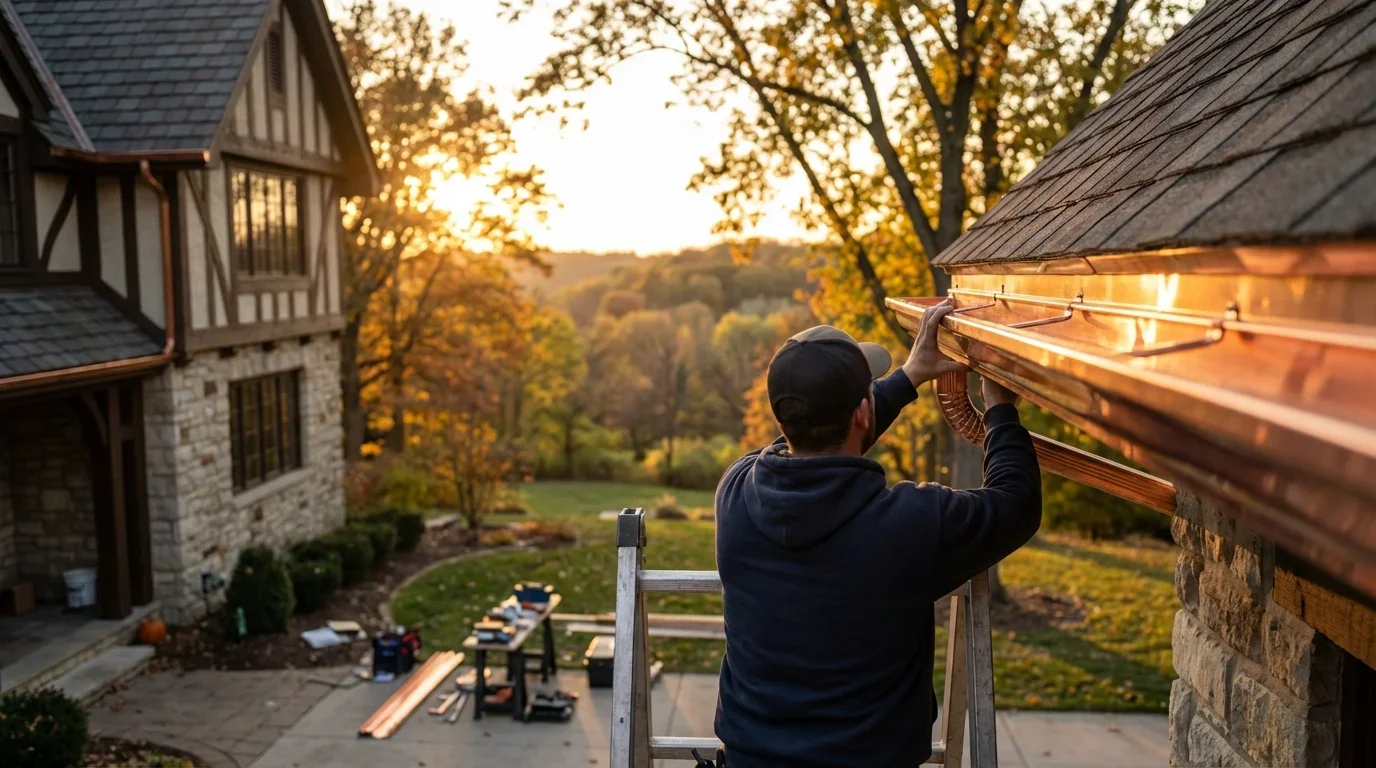

Why Copper Gutters for High-End Fox Valley Homes
You've invested in architectural shingles, custom trim work, professional landscaping. Then you look up and see builder-grade aluminum gutters — white seams, visible hangers, that cheap baked-on finish already chalking after three years.
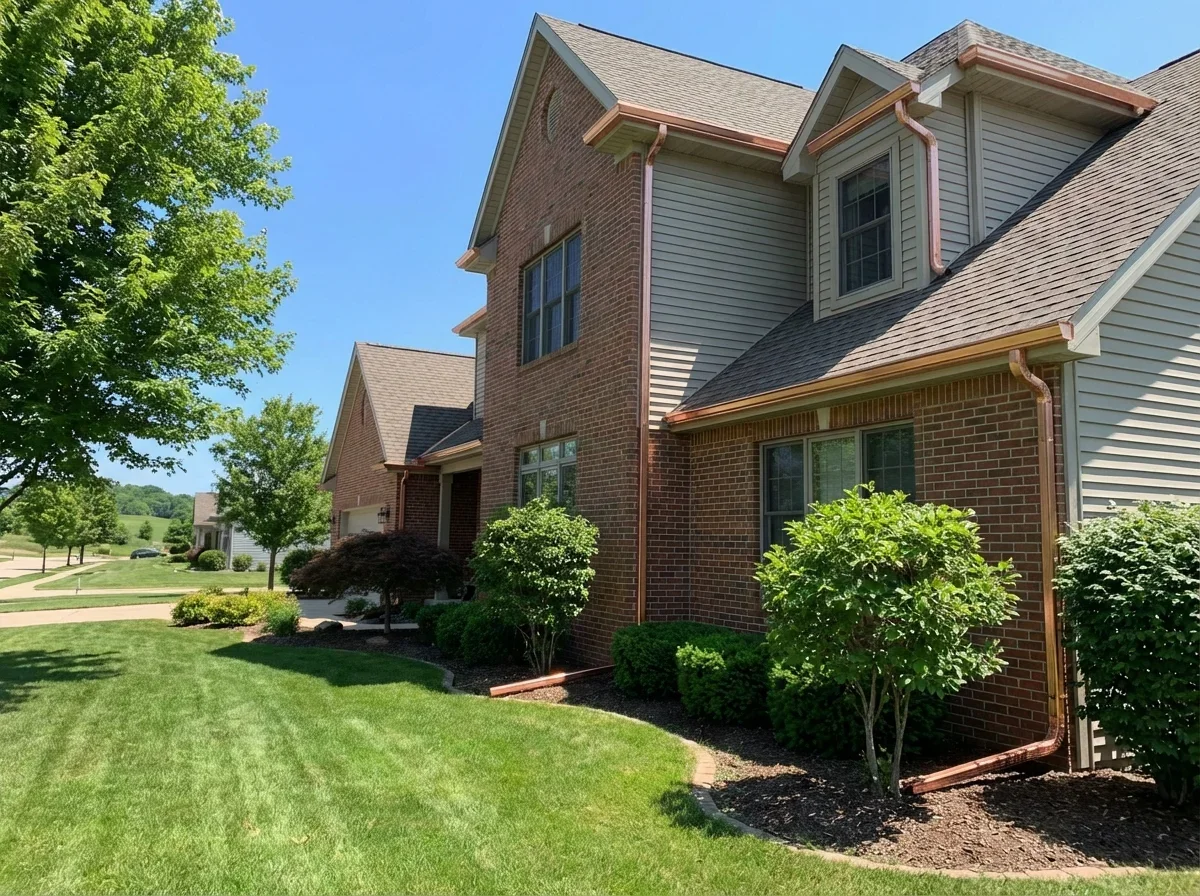
Copper is the last gutter system you'll ever install. For historic homes in Neenah and Menasha, it's often the only material that matches the original construction — those half-round profiles with hidden hangers that disappear into the roofline. For new custom builds in Oshkosh and Kaukauna, it's the detail that separates a $600k house from a $900k house.
The material doesn't just last longer than aluminum. It performs better in Wisconsin's climate. Copper naturally resists the corrosion that eats through coated metals when road salt spray hits your fascia every winter. No paint to chip. No seams to split when ice dams form.
The ROI is real. Copper gutters add 2-4% to resale value on homes over $400k in the Fox Valley market. Appraisers recognize the material upgrade — it signals quality throughout the property.
Patina Development and Finish Options
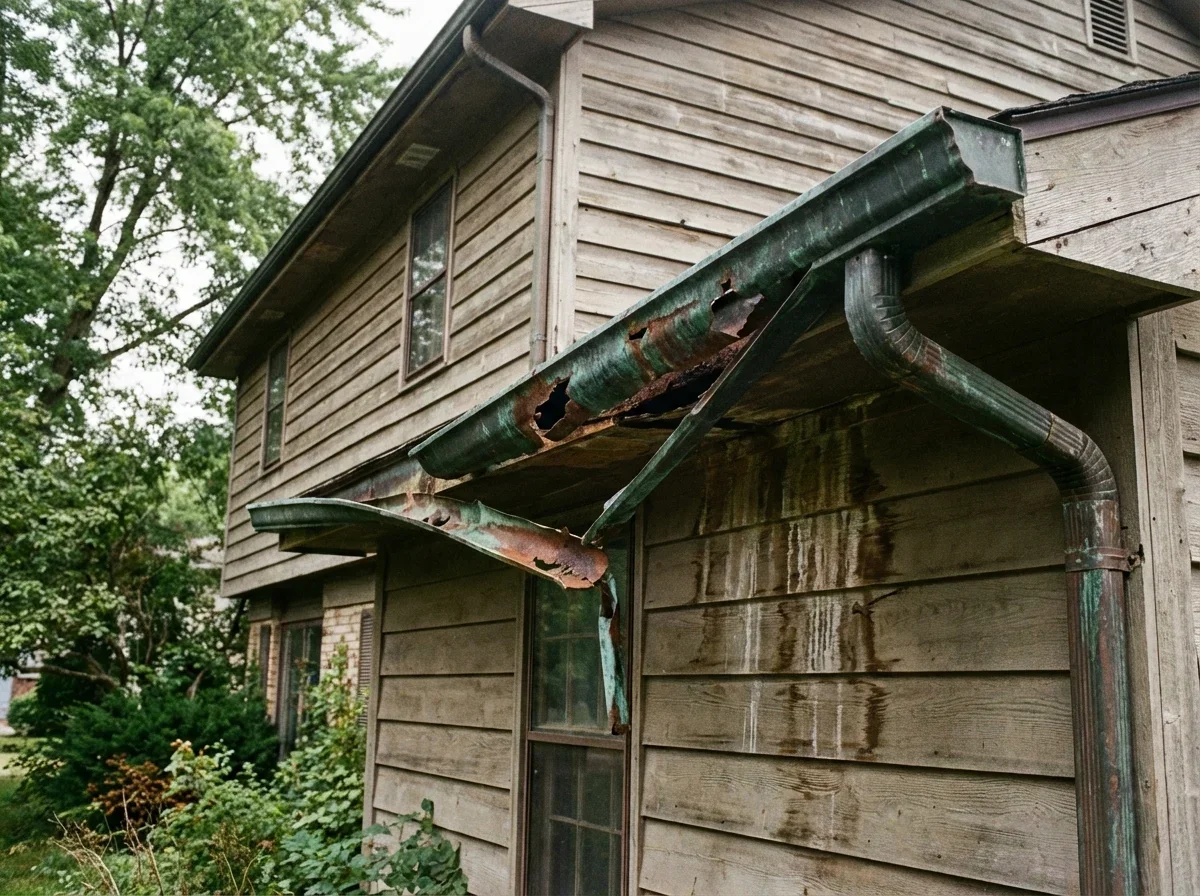
New copper is bright penny-orange. Within six months in Fox Valley's humid summers and freeze-thaw winters, it darkens to bronze. After 2-3 years, the classic green patina starts forming — that weathered verdigris you see on historic buildings.
You can accelerate the patina with chemical treatments if you want the aged look immediately. Or seal the copper to keep that bright metallic finish permanently. Most homeowners let nature work — the gradual transformation is part of the appeal.
The patina isn't cosmetic. It's a protective oxide layer that makes copper self-healing. Scratch aluminum and you expose bare metal that corrodes. Scratch copper and the patina reforms.
What Do Copper Gutters Cost in the Fox Valley?
Expect $25-40 per linear foot installed — roughly 3-4 times the cost of premium aluminum. For a typical 2,500 sq ft home with 180 linear feet of gutters and six downspouts, you’re looking at $5,500-8,000 total.
That number varies based on profile, installation complexity, and whether you’re matching historic details. Here’s the breakdown:
Installation Complexity Factors
Soldered seams add $8-12 per linear foot over mechanically fastened systems, but they’re the difference between a gutter that looks mass-produced and one that looks handcrafted. Historic homes in Appleton’s College Avenue district typically require soldered work to match the original installation.
Copper expands and contracts significantly with Wisconsin’s 140-degree annual temperature swing. Proper bracket spacing (every 24 inches vs 36 for aluminum) prevents the wave effect you see when expansion joints aren’t calculated correctly.
Hidden hanger systems cost more upfront but deliver that clean roofline where the gutter appears to float beneath the fascia — no visible hardware interrupting the patina.
30-Year Cost Comparison
When you’re planning to stay in your Green Bay home for 15+ years, the math changes. You’re not paying a premium — you’re pre-paying for three aluminum replacements you won’t need.
The Copper Gutter Installation Process
This isn't a one-day seamless gutter truck operation. Proper copper installation takes 3-5 days for most Fox Valley homes, with fabrication happening on-site to ensure exact fit.
Fabrication and Fitting
The installer templates your roofline, measuring pitch, fascia irregularities, and calculating expansion allowances for seasonal temperature shifts. Copper stock arrives in 10-foot sections or custom lengths — never continuous like aluminum extrusion.
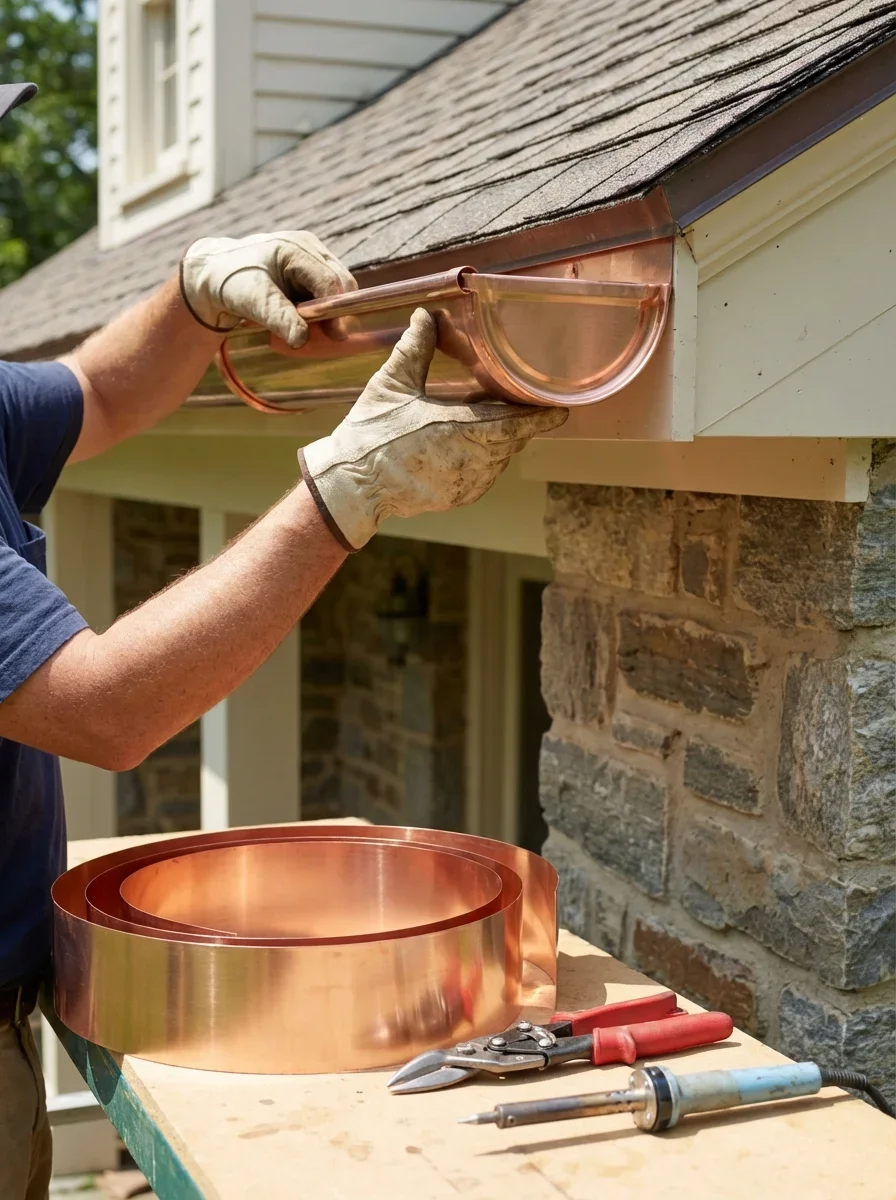
Each section is hand-formed to match your chosen profile. For half-round systems on historic homes, this means shaping the curve on a brake or using a roller die to achieve the period-accurate radius. K-style profiles require folding multiple bends to create that ogee face.
Fitting happens before any permanent fastening. The installer dry-fits the entire system, checks pitch (minimum ¼-inch drop per 10 feet), and confirms downspout locations drain away from foundations — critical in Wisconsin where spring snowmelt can dump 3 inches of water in 48 hours.
Soldering and Seam Work
European-style copper gutters use soldered joints instead of slip connectors. The installer cleans both mating surfaces, applies flux, and torch-solders the seam. Done right, the joint is stronger than the surrounding copper and completely watertight without caulk.
This is where installer skill separates adequate work from museum-quality installation. Overheating discolors the copper. Insufficient solder creates a weak joint that fails when ice loading stresses the system. The best installers in Neenah and Menasha learned this craft working on historic restoration projects where the seam work has to match 100-year-old examples.
Hanger and Bracket Systems
Copper weighs more than aluminum — roughly 50% heavier when filled with water. Standard aluminum hangers won't support the load. Wisconsin Historical Society standards recommend stronger hanger systems with reduced spacing for historic properties[2], and those same principles apply to new copper installations.
Hidden bracket systems mount to the fascia or roof deck, with the gutter clipping into the bracket from below. Strap hangers loop over the roof edge under the first course of shingles, creating support without visible hardware.
Every bracket location gets sealed according to membrane manufacturer specs to maintain roof warranty compliance[1]. This matters more in Wisconsin than dry climates — ice dams exploit any penetration.
How to Choose a Copper Gutter Installer
Most gutter contractors in the Fox Valley install aluminum and vinyl. Fewer than 20% have copper fabrication experience. You're not just hiring someone to hang gutters — you're hiring a craftsperson who understands metalworking.
Specialized Skills Required
Ask how many copper installations they've completed in the last two years. One or two jobs means they're learning on your dime. Ten or more means they've solved the tricky details — thermal expansion calculations, patina sealing options, matching historic profiles.
Request photos of soldered seams on completed projects. You should see smooth, consistent joints without excess solder buildup or discoloration. If they only show you mechanically fastened work, they're not qualified for high-end installations.
Can they fabricate custom profiles? If you're matching a historic home in Appleton's Prospect Avenue Historic District, you may need a specific half-round diameter or a custom ogee shape that isn't available in stock profiles.
Portfolio and Historic Work
Look for completed projects on homes similar to yours in age and architectural style. A contractor who specializes in modern K-style copper for new construction may not have the experience to replicate a 1910 half-round system on a Queen Anne in Oshkosh.
Ask about their supplier relationships. The best installers source from specialty copper suppliers who carry 16-oz and 20-oz material (not just the standard 16-oz), giving you options for extra-heavy systems on homes with large roof areas or areas prone to ice dams.
Questions to ask every candidate:
- Do you solder seams or use mechanical connectors? (Soldered is superior for copper)
- What's your hanger spacing on copper systems? (Should be 24 inches max)
- How do you handle thermal expansion in Wisconsin's climate? (Should mention expansion joints or floating brackets)
- Do you offer patina treatment options? (Natural, accelerated, or sealed)
- What's your warranty on copper installations? (Minimum 10 years on labor, lifetime on material)
The right installer talks about craftsmanship, not speed. They ask about your home's architectural details and whether you want to match historic accuracy or create a modern interpretation. They show you material samples and explain the patina timeline specific to the Fox Valley's climate.
When you're investing $6,000-8,000 in a gutter system that will outlast your roof, choosing based on the lowest bid is choosing wrong. The $1,500 savings disappears the first time you have to repair poorly soldered seams or replace brackets that weren't sized for copper's weight.
Frequently Asked Questions
The cost of 200 linear feet of gutters varies significantly by material and installation:
| Material | Cost per LF | Total for 200 LF | Notes |
|---|---|---|---|
| Aluminum (standard) | $5–$12 | $1,000–$2,400 | Most common, budget-friendly |
| Aluminum (seamless) | $8–$15 | $1,600–$3,000 | Custom-fitted, fewer leaks |
| Vinyl | $4–$10 | $800–$2,000 | Lightweight, budget option, less durable |
| Copper | $15–$25+ | $3,000–$5,000+ | Premium, longest lifespan |
| Steel | $8–$14 | $1,600–$2,800 | Heavy-duty, rust-prone in Wisconsin |
| K-Style (aluminum) | $6–$12 | $1,200–$2,400 | Popular decorative profile |
Additional costs to include:
- Downspout installation/repair — $100–$300 per downspout
- Gutter guards or leaf guards — $5–$15 per LF ($1,000–$3,000 for 200 LF)
- Removal of old gutters — $200–$500
- Labor and installation — typically $1–$3 per LF ($200–$600)
- Ice dam prevention — $500–$1,500+
Wisconsin-specific note: Budget for potential ice dam treatment and extra downspout capacity due to winter snow melt. Get 2–3 local quotes, as pricing varies by gutter company and seasonal demand.
- Wisconsin Department of Administration, Division of Energy, Housing and Community Services. "State of Wisconsin Home Investment Partnerships Act Minimum Rehabilitation Standards." https://energyandhousing.wi.gov/Documents/Housing/HHR/Minimum%20rehab%20standards.pdf. Accessed February 11, 2026.
- Wisconsin Historical Society. "Maintaining the Gutters on Your Historic House." https://www.wisconsinhistory.org/Records/Article/CS4283. Accessed February 11, 2026.
Related Articles
Copper & Half-Round Gutters: Premium Options Your Contractor Can Install
Learn what makes copper gutters and half-round systems premium choices, how contractors install them, what they cost, and how to find qualified installers in Fox Valley.
Read Guide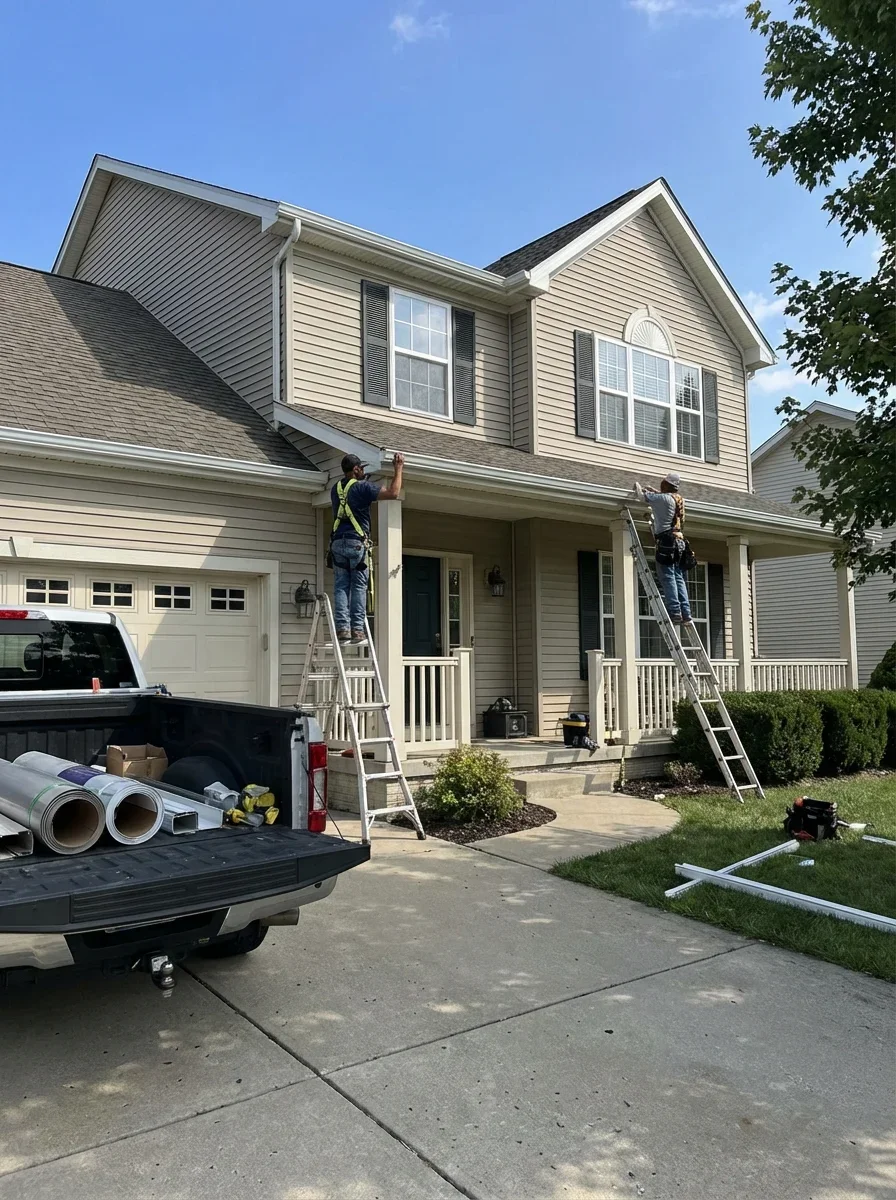
How Much Does Gutter Installation Cost? Pricing Guide
Gutter installation costs $6-$14 per linear foot for aluminum, $15-$30 for copper. Learn what drives pricing, what quality installation includes, and how to compare contractor quotes.
Read Cost Guide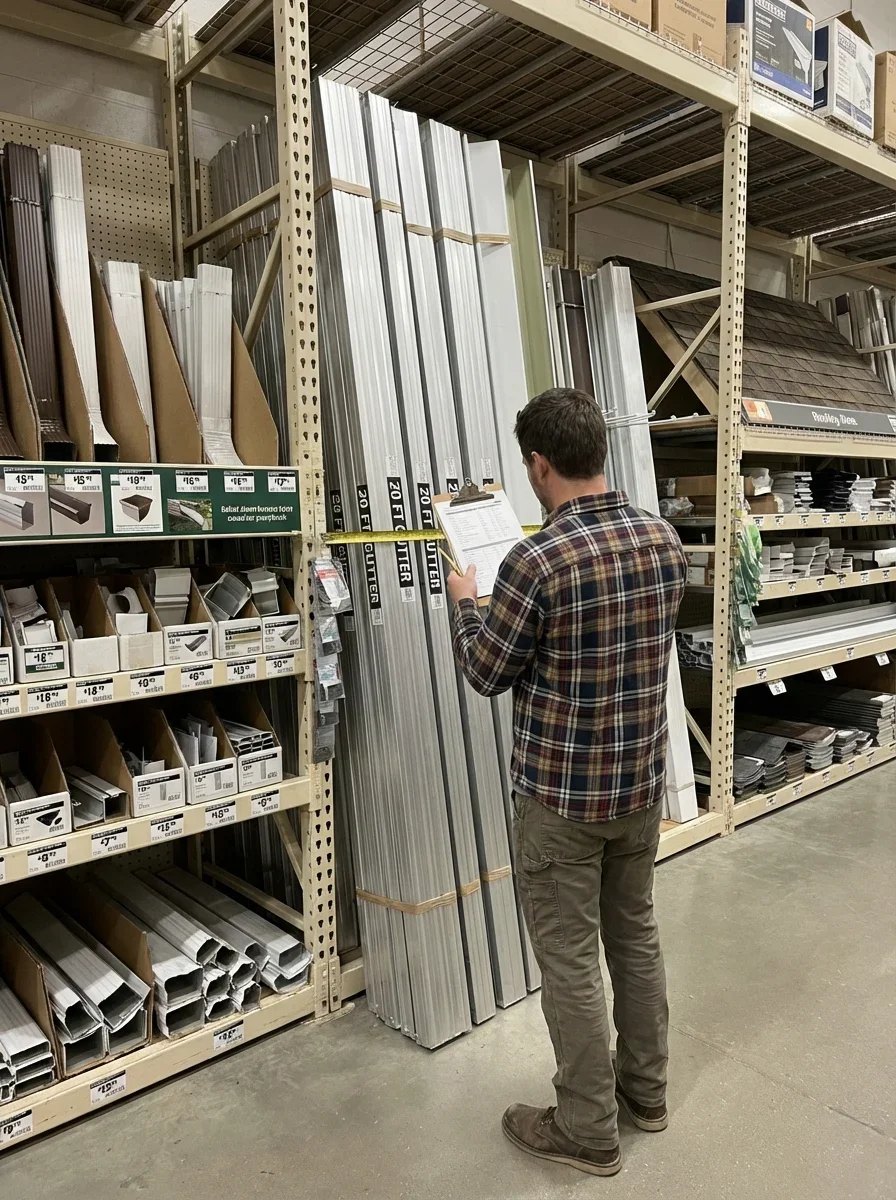
20-Foot Gutters: Sizes, Materials & Why Installation Matters
Researching 20-foot gutter sections? Learn why gutter size matters, what materials contractors use, and why professional installation beats DIY.
Read Guide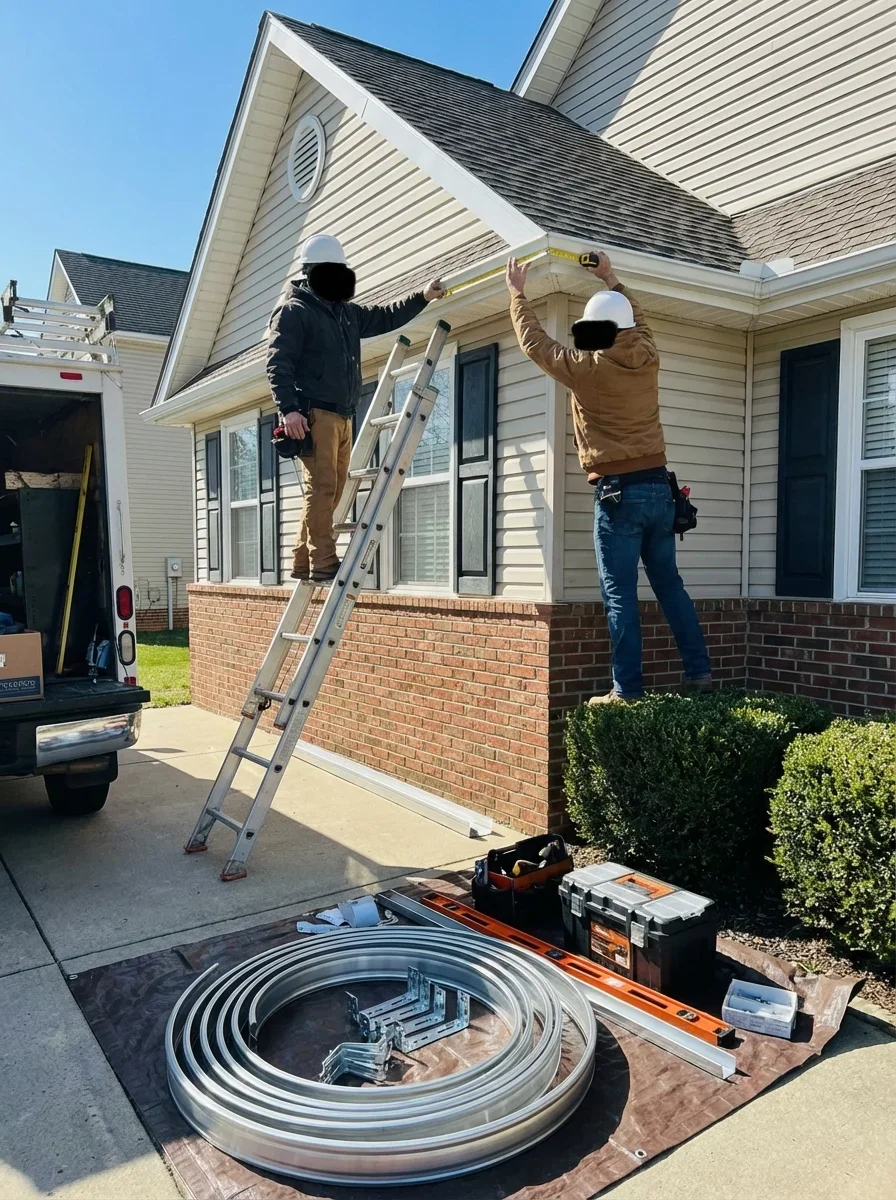
Gutter Installation Services: What to Expect & How to Hire
Learn what professional gutter installation involves, how contractors determine the right system for your home, and what quality installation should cost.
Read Guide