



What Are Half Round Gutters?
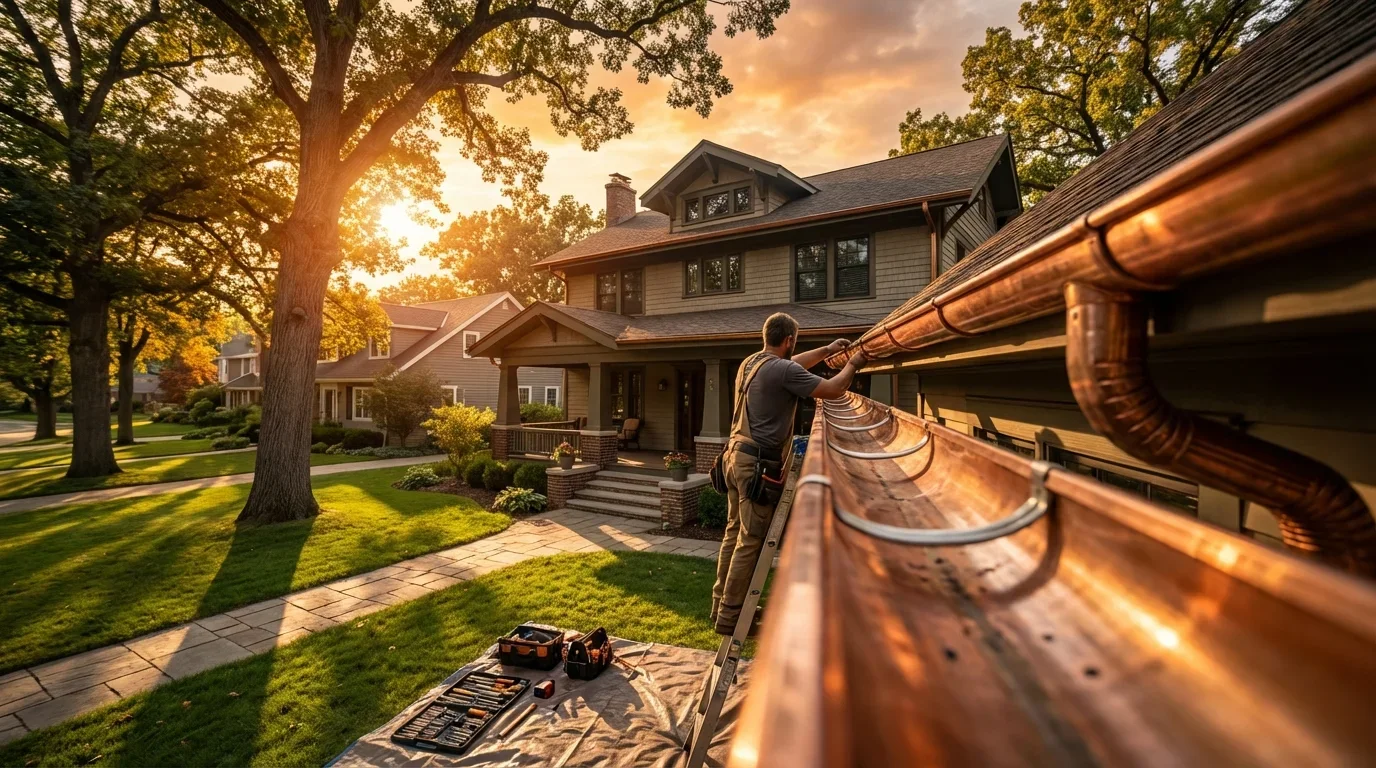
Half-round gutters have a semi-circular cross-section — exactly what the name suggests. Picture a tube cut lengthwise down the middle. That smooth, rounded profile was the standard gutter design in America from the 1880s through the 1940s, borrowed from European building traditions.
Then came K-style gutters in the 1950s. Flat backs, decorative ogee fronts, easier installation on standard fascia boards. Builders switched en masse. By the 1970s, half-round gutters had essentially disappeared from new construction.
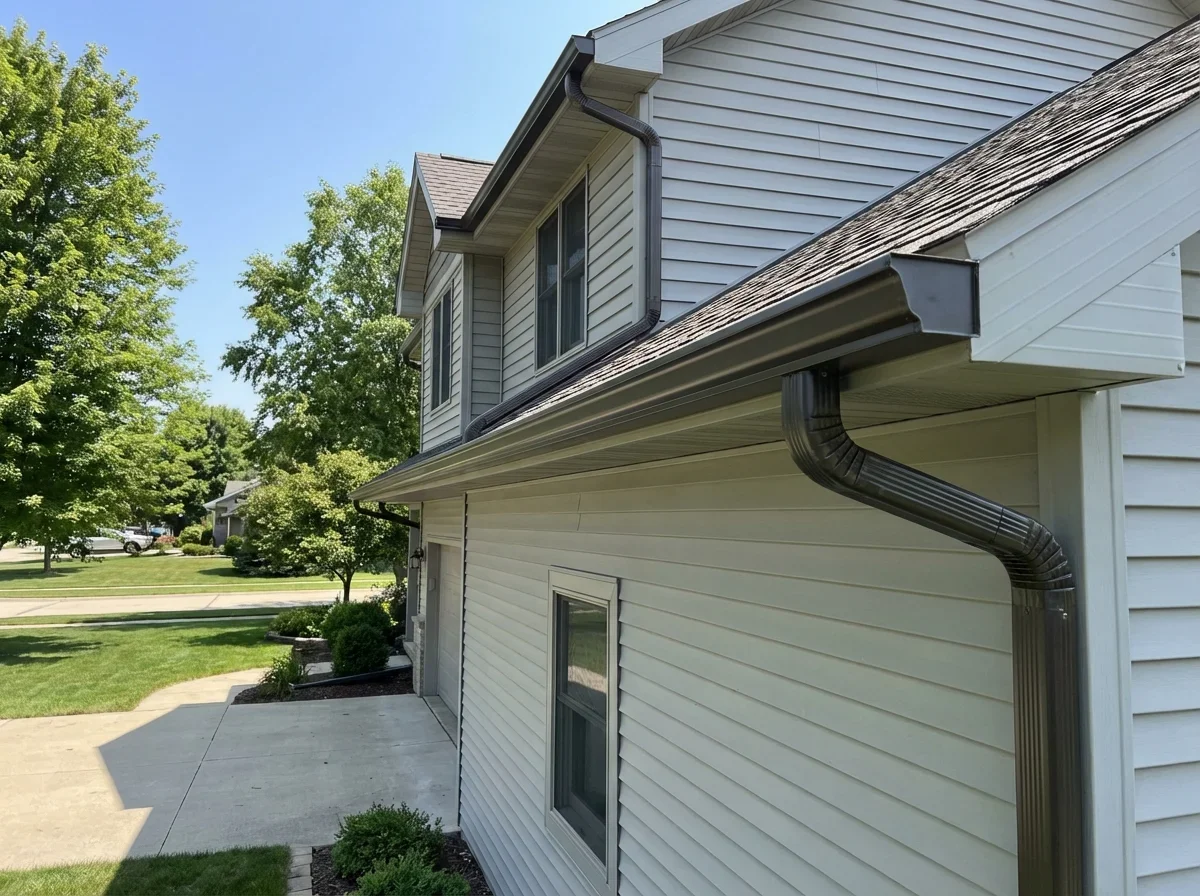
But K-style gutters look wrong on period architecture. A Tudor Revival in Green Bay with modern K-style gutters is like wearing sneakers with a tuxedo. The profile breaks the roofline. The aesthetic doesn't match.
Profile and Historic Context
Half-round gutters mount differently than modern systems. Traditional installations used decorative strap brackets or ornate hangers that wrapped over the gutter and fastened to the fascia or roof edge. You can see these on historic homes throughout downtown Appleton and Oshkosh's Washington Avenue district.
Contemporary half-round systems use hidden internal hangers, similar to K-style mounting but engineered for the circular profile. The clean look preserves the historic aesthetic without exposed hardware.
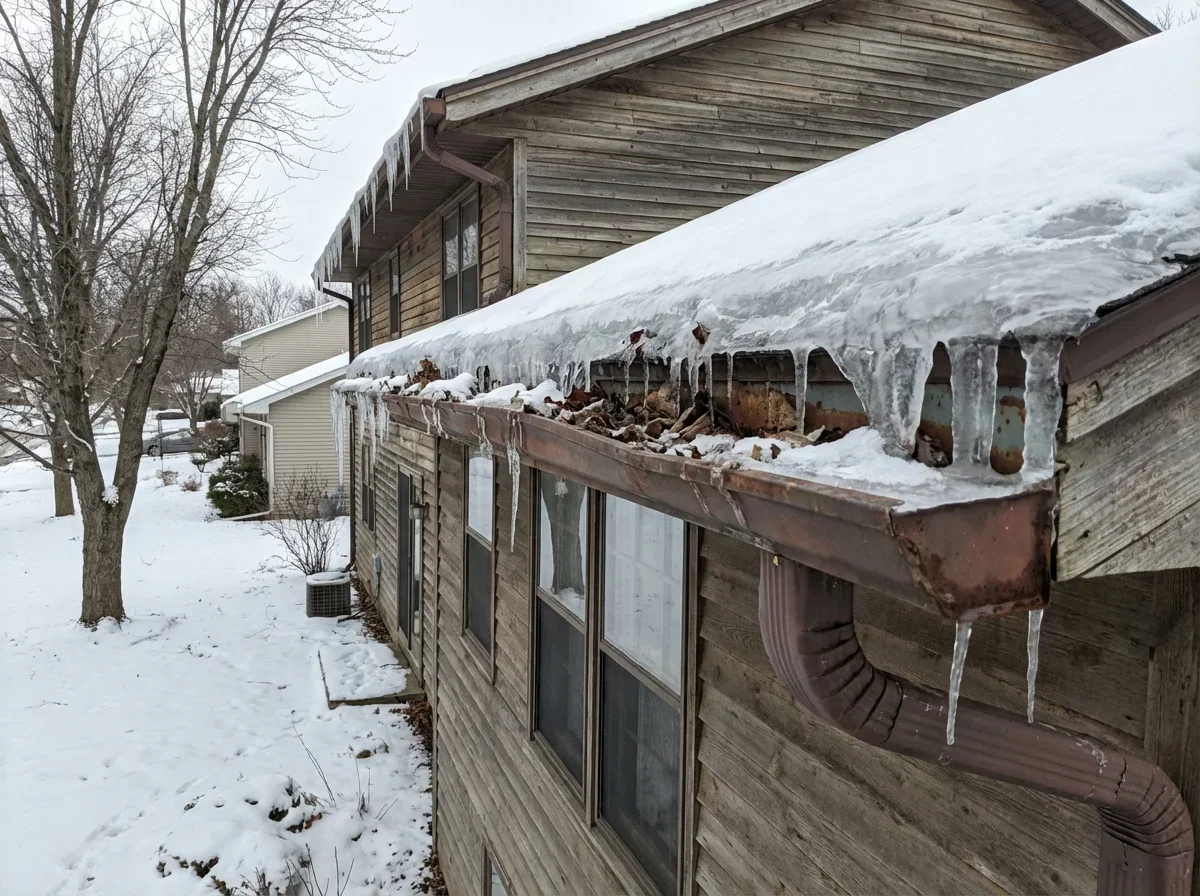
The semi-circular shape creates a smooth interior with no seams or corners. Water flows cleanly. Debris doesn't catch in angular pockets the way it does in K-style gutters. That matters in the Fox Valley where spring pollen, fall leaves, and winter ice accumulation cycle through every year.
Half Round vs. K-Style Comparison
K-style gutters hold more water. The flat back and angular design creates roughly 20% more capacity than an equivalent-diameter half-round gutter. For Fox Valley's 32 inches of annual rainfall and heavy spring snow melts, that capacity difference means half-round systems need proper sizing — often going with 6-inch diameter where 5-inch K-style would suffice.
K-style gutters cost less to install. Standard stock, faster mounting, wider contractor availability. Half-round is a specialty product requiring contractors who understand historic detailing and work with premium materials.
But capacity and cost aren't the point. Half-round gutters are about architectural integrity. If you're restoring a 1920s Craftsman in Menasha or building a high-end custom home in Kaukauna that respects traditional design, the correct gutter profile isn't negotiable. It's part of the architecture.
The ROI is real. Period-appropriate gutters on historic homes in Appleton and Neenah historic districts significantly impact property value. Architectural reviewers and preservation-minded buyers notice these details.
What Do Half Round Gutters Cost in the Fox Valley?
Expect $18–$35 per linear foot installed for half-round gutters in the Fox Valley. That’s roughly double what K-style aluminum gutters cost. The premium comes from material costs, specialized labor, and limited contractor availability.
A typical Fox Valley home needs 150–180 linear feet of gutter. At those rates, you’re looking at $2,700–$6,300 for a complete half-round system. Compare that to $1,200–$2,700 for standard K-style aluminum.
Material Cost Breakdown
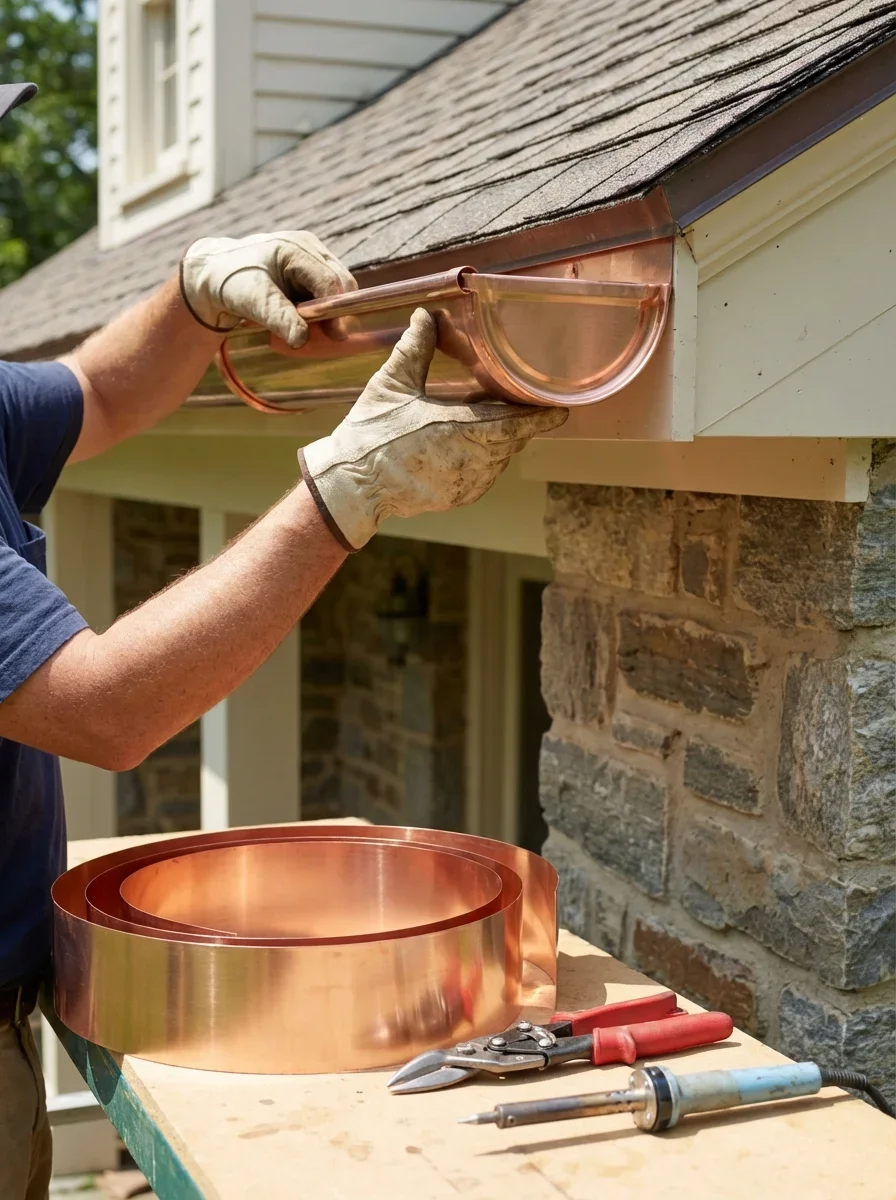
Copper dominates high-end historic restorations. The material develops a green patina over 7–15 years depending on exposure and humidity. In the Fox Valley’s climate, expect faster patina development on north-facing roof sections where moisture lingers. Some homeowners love the aged look. Others prefer keeping copper bright with clear coatings — which adds maintenance costs.
Aluminum half-round offers the profile at lower cost. Factory-painted finishes come in colors that match historic paint schemes. Mill-finish aluminum (unpainted) costs less but shows every scratch and oxidizes to a chalky gray within a few years.
Installation Labor Factors
Labor runs $8–$15 per linear foot depending on installation complexity. Factors that increase costs:
- Two-story installations requiring scaffolding or lift equipment
- Hidden hanger systems that mount inside the gutter (cleaner look, more time-intensive)
- Seamless fabrication done on-site with specialized equipment (preferred for runs over 20 feet)
- Fascia repair before installation — half-round gutters expose poor fascia conditions
- Custom bracket work for historic restoration projects in Oshkosh or Appleton historic districts
Many Fox Valley contractors who install K-style gutters won’t touch half-round systems. The equipment is different. The fabrication techniques are different. The mounting requires more precision. You’re paying for specialized expertise, not just materials.
Cost Comparison Table
Here’s what a typical 160-foot gutter system costs installed:
| System Type | Material | Total Cost | Cost per LF |
|---|---|---|---|
| K-Style Aluminum | Painted aluminum | $1,600–$2,400 | $10–$15 |
| Half-Round Aluminum | Painted aluminum | $3,200–$4,500 | $20–$28 |
| Half-Round Copper | Copper (16 oz) | $4,800–$6,400 | $30–$40 |
These numbers assume standard single-story installation with accessible roof edges. Add 30–50% for complex rooflines or historic restoration requirements.
The Half Round Gutter Installation Process
Half-round gutter installation starts with a site assessment that focuses on fascia condition and roof edge details. Unlike K-style gutters that hide fascia imperfections behind a flat back, half-round profiles expose the entire fascia face. Rotten or damaged boards need replacement first.
Fascia Inspection and Preparation
The contractor examines fascia boards for rot, particularly at rafter tails where ice dams concentrate. Green Bay and Appleton homes with north-facing rooflines often show fascia deterioration. Hidden hanger installations require solid wood backing. The contractor marks rafter locations and verifies blocking where rafters space wider than 24 inches.
Pitch Layout and Hanger Placement
Half-round gutters need 1/4 inch of drop per 10 feet of run — slightly more aggressive than K-style systems because the rounded bottom collects standing water if pitched too shallow. The contractor snaps chalk lines and marks hanger positions. Hidden hangers space 24–30 inches apart. Traditional strap brackets show on the exterior and space 36–48 inches apart.
Seamless Fabrication or Section Assembly
Seamless gutters get fabricated on-site using a portable roll-forming machine. The contractor feeds flat metal coil through the machine, shaping it into the half-round profile in continuous sections up to 50 feet long. Seamed systems use 10-foot sections with slip joints or soldered connections. Copper gutters traditionally get soldered — a skill fewer contractors master each year.
Downspout and Outlet Installation
Half-round downspouts match the round profile, typically 3–4 inches in diameter. Round outlets require hole saws and careful sealing. Each outlet location needs a downspout route planned to daylight at least 4–6 feet from the foundation — critical in Fox Valley clay soils that hold moisture.
Final Detailing
The contractor seals all joints, tests water flow with a garden hose, and installs end caps. Copper systems get left raw or coated depending on homeowner preference. Aluminum systems get touch-up paint on cut edges. The entire installation takes 1–2 days for a typical single-family home, longer for complex historic work.
Installation season matters. Most Fox Valley contractors schedule half-round work for May through October. Cold weather complicates sealant curing and metal handling. Copper work especially suffers in freezing temperatures.
How to Choose a Half Round Gutter Contractor
Not every gutter contractor works with half-round systems. Start by asking if they have the fabrication equipment and experience. Many Fox Valley companies focus exclusively on K-style aluminum because that's what 95% of homeowners request.
Experience with Historic Homes
If you're restoring a period home in Appleton's Historic District or Oshkosh's Algoma Boulevard neighborhood, ask for references from similar projects. Historic work requires understanding architectural details — bracket styles, material authenticity, color matching for painted finishes.
Ask to see photos of completed half-round installations, particularly copper work if that's your material choice. Soldered copper joints should look clean with no excess solder blobs. Hidden hanger installations should show consistent pitch with no sagging sections.
Material Sourcing and Fabrication
Ask where the contractor sources materials. Local fabrication means faster turnaround and easier warranty service. Some contractors order pre-formed sections from regional suppliers, while others fabricate on-site with portable equipment. On-site fabrication reduces seams but requires the right equipment and skill.
For copper systems, ask about metal gauge. Residential half-round gutters typically use 16-ounce copper (about 0.021 inches thick). Twenty-ounce copper costs more but lasts longer and resists denting from ladder contact and ice impact. Cheap copper work uses 12-ounce material that dents easily.
Questions to Ask
- How many half-round systems do you install per year?
- Do you fabricate seamless sections or use pre-formed materials?
- What's your preferred hanger system for my home style?
- Can you match existing brackets on my historic home?
- How do you handle fascia repairs discovered during installation?
- What's your warranty on materials and labor?
- Do you pull permits for gutter replacement in Neenah/Menasha/Kaukauna?
Red flags: Contractors who suggest half-round gutters for purely functional reasons probably don't understand the product. Half-round is an aesthetic choice for historic authenticity or high-end design, not a performance upgrade over K-style. If a contractor can't explain why you'd choose half-round besides "they look nice," keep looking.
The right contractor understands that half-round gutters are part of your home's architectural language, not just a drainage system. They'll discuss profile accuracy, material appropriateness for your home's era, and bracket details that matter to historic preservation. That specialized knowledge separates competent half-round installers from generic gutter contractors.
Compare contractors who demonstrate experience with period-appropriate installations and material handling. The investment in proper half-round gutters pays off in architectural integrity and long-term performance — but only when installed by someone who knows what they're doing.
Frequently Asked Questions
The cost of 200 linear feet of gutters varies significantly by material and installation:
| Material | Cost per LF | Total for 200 LF | Notes |
|---|---|---|---|
| Aluminum (standard) | $5–$12 | $1,000–$2,400 | Most common, budget-friendly |
| Aluminum (seamless) | $8–$15 | $1,600–$3,000 | Custom-fitted, fewer leaks |
| Vinyl | $4–$10 | $800–$2,000 | Lightweight, budget option, less durable |
| Copper | $15–$25+ | $3,000–$5,000+ | Premium, longest lifespan |
| Steel | $8–$14 | $1,600–$2,800 | Heavy-duty, rust-prone in Wisconsin |
| K-Style (aluminum) | $6–$12 | $1,200–$2,400 | Popular decorative profile |
Additional costs to include:
- Downspout installation/repair — $100–$300 per downspout
- Gutter guards or leaf guards — $5–$15 per LF ($1,000–$3,000 for 200 LF)
- Removal of old gutters — $200–$500
- Labor and installation — typically $1–$3 per LF ($200–$600)
- Ice dam prevention — $500–$1,500+
Wisconsin-specific note: Budget for potential ice dam treatment and extra downspout capacity due to winter snow melt. Get 2–3 local quotes, as pricing varies by gutter company and seasonal demand.
Related Articles
Copper & Half-Round Gutters: Premium Options Your Contractor Can Install
Learn what makes copper gutters and half-round systems premium choices, how contractors install them, what they cost, and how to find qualified installers in Fox Valley.
Read Guide
How Much Does Gutter Installation Cost? Pricing Guide
Gutter installation costs $6-$14 per linear foot for aluminum, $15-$30 for copper. Learn what drives pricing, what quality installation includes, and how to compare contractor quotes.
Read Cost Guide
20-Foot Gutters: Sizes, Materials & Why Installation Matters
Researching 20-foot gutter sections? Learn why gutter size matters, what materials contractors use, and why professional installation beats DIY.
Read Guide
Gutter Installation Services: What to Expect & How to Hire
Learn what professional gutter installation involves, how contractors determine the right system for your home, and what quality installation should cost.
Read Guide